自然语言推理 —— 文本蕴含
"t 蕴含 h" 意思是读到 t 的人会得出 h 为真的结论。NLI 就是预测蕴含 / 矛盾 / 中性的任务。表面无聊,生产里却是承重墙。
类型: Learn 语言: Python 前置要求: Phase 5 · 05(情感分析)、Phase 5 · 13(问答) 预计时间: ~60 分钟
问题背景
你做了个摘要器。它产出了一份摘要。你怎么知道摘要里没有幻觉?
你做了个聊天机器人。它答了 "yes"。你怎么知道这个答案被检索到的段落支持?
你要给 10000 篇新闻按主题分类。你没有训练标签。能复用一个模型吗?
这三个问题都归约成自然语言推理。NLI 问:给定前提 t 和假设 h,h 是被 t 蕴含、矛盾,还是中性(无关)?
- 幻觉检查:
t= 源文档,h= 摘要论断。非蕴含 = 幻觉。 - 接地 QA:
t= 检索到的段落,h= 生成的答案。非蕴含 = 编造。 - Zero-shot 分类:
t= 文档,h= 措辞化的标签("This is about sports")。蕴含 = 预测标签。
一个任务,三种生产用途。这就是为什么每个 RAG 评估框架底下都藏着一个 NLI 模型。
核心概念
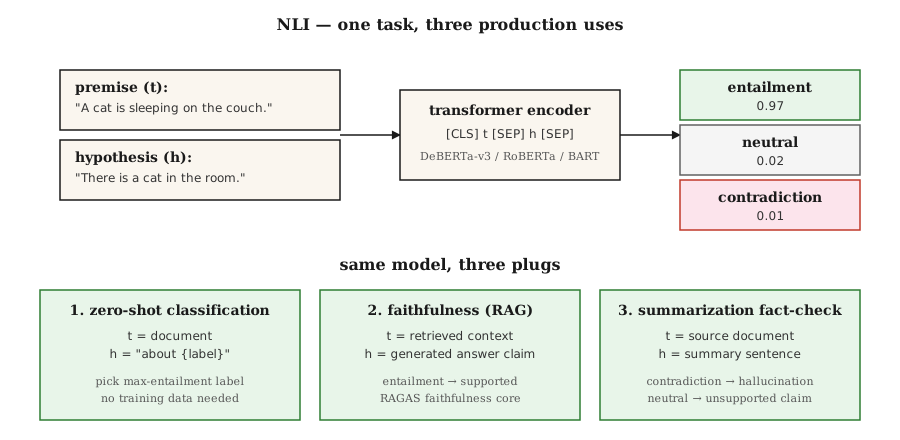
三个标签。
- 蕴含(Entailment)。
t→h。"The cat is on the mat" 蕴含 "There is a cat"。 - 矛盾(Contradiction)。
t→ ¬h。"The cat is on the mat" 与 "There is no cat" 矛盾。 - 中性(Neutral)。 两个方向都推不出。"The cat is on the mat" 对 "The cat is hungry" 是中性的。
不是逻辑蕴含。 NLI 是自然语言推理——一个典型的人类读者会推出什么,而非严格逻辑。在 NLI 里,"John walked his dog" 蕴含 "John has a dog",但严格的一阶逻辑只有在你把"拥有"公理化之后才承认它。
数据集。
- SNLI(2015)。57 万人工标注的对,以图片说明为前提。领域窄。
- MultiNLI(2017)。跨 10 种体裁的 43.3 万对。2026 年的标准训练语料。
- ANLI(2019)。对抗式 NLI。人类专门写出设计来打破现有模型的例子。更难。
- DocNLI、ConTRoL(2020–21)。文档长度的前提。测试多跳和长程推理。
架构。 一个 transformer 编码器(BERT、RoBERTa、DeBERTa)读 [CLS] premise [SEP] hypothesis [SEP]。[CLS] 表示喂给一个 3 路 softmax。在 MNLI 上训练,在留出基准上评估,在分布内的对上拿到 90%+ 的准确率。
通过 NLI 做 zero-shot。 给定文档和候选标签,把每个标签变成一个假设("This text is about sports")。算每个的蕴含概率。取最大的。这就是 Hugging Face 的 zero-shot-classification 流水线背后的机制。
nli-router动手构建
第 1 步:跑一个预训练 NLI 模型
from transformers import pipeline

nli = pipeline("text-classification",
               model="facebook/bart-large-mnli",
               top_k=None)  # 返回所有标签;替代已弃用的 return_all_scores=True

premise = "The cat is sleeping on the couch."
hypothesis = "There is a cat in the room."

result = nli({"text": premise, "text_pair": hypothesis})[0]
print(result)
# [{'label': 'entailment', 'score': 0.97},
#  {'label': 'neutral', 'score': 0.02},
#  {'label': 'contradiction', 'score': 0.01}]
做生产 NLI,facebook/bart-large-mnli 和 microsoft/deberta-v3-large-mnli 是开源默认。DeBERTa-v3 居榜首。
第 2 步:zero-shot 分类
zs = pipeline("zero-shot-classification", model="facebook/bart-large-mnli")

text = "The stock market rallied after the central bank cut interest rates."
labels = ["finance", "sports", "politics", "technology"]

result = zs(text, candidate_labels=labels)
print(result)
# {'labels': ['finance', 'politics', 'technology', 'sports'],
#  'scores': [0.92, 0.05, 0.02, 0.01]}
模板默认是 "This example is about {label}."。用 hypothesis_template 自定义。不需要训练数据。不需要微调。开箱即用。
第 3 步:RAG 的忠实度检查
def is_faithful(answer, context, threshold=0.5):
    result = nli({"text": context, "text_pair": answer})[0]
    entail = next(s for s in result if s["label"] == "entailment")
    return entail["score"] > threshold
这就是 RAGAS 忠实度的核心。把生成的答案拆成原子论断。拿每个论断对照检索到的上下文检查。报告蕴含的比例。
第 4 步:手搓 NLI 分类器(概念性)
仅标准库的玩具实现见 code/main.py:前提和假设通过词面重叠 + 否定检测来比较。比不过 transformer 模型——但它展示了任务的形状:两段文本进,3 路标签出,损失 = 在 \{entail, contradict, neutral\} 上的交叉熵。
坑
- 只看假设的捷径。 模型能仅凭假设就在 SNLI 上以约 60% 预测标签,因为 "not"、"nobody"、"never" 和矛盾相关。这是检测标签泄漏的强基线。
- 词面重叠启发式。 子序列启发式("每个子序列都被蕴含")能过 SNLI,却在 HANS/ANLI 上翻车。用对抗式基准。
- 文档长度退化。 单句 NLI 模型在文档长度的前提上掉 20+ F1。长上下文用 DocNLI 训练的模型。
- zero-shot 模板敏感。 "This example is about {label}" vs "{label}" vs "The topic is {label}" 能把准确率摆动 10+ 个点。调模板。
- 领域不匹配。 MNLI 在通用英语上训练。法律、医学、科学文本需要领域专用 NLI 模型(如 SciNLI、MedNLI)。
实际使用
2026 年的栈:
| 用例 | 模型 |
|---|---|
| 通用 NLI | microsoft/deberta-v3-large-mnli |
| 快 / 边缘 | cross-encoder/nli-deberta-v3-base |
| zero-shot 分类(轻量) | facebook/bart-large-mnli |
| 文档级 NLI | MoritzLaurer/DeBERTa-v3-large-mnli-fever-anli-ling-wanli |
| 多语言 | MoritzLaurer/multilingual-MiniLMv2-L6-mnli-xnli |
| RAG 里的幻觉检测 | RAGAS / DeepEval 里的 NLI 层 |
2026 年的元模式:NLI 是文本理解的强力胶带。每当你需要"A 支持 B 吗?"或"A 与 B 矛盾吗?"——在伸手再发一次 LLM 调用之前,先伸手抓 NLI。
拿去用
存为 outputs/skill-nli-picker.md:
---
name: nli-picker
description: Pick an NLI model, label template, and evaluation setup for a classification / faithfulness / zero-shot task.
version: 1.0.0
phase: 5
lesson: 21
tags: [nlp, nli, zero-shot]
---

Given a use case (faithfulness check, zero-shot classification, document-level inference), output:

1. Model. Named NLI checkpoint. Reason tied to domain, length, language.
2. Template (if zero-shot). Verbalization pattern. Example.
3. Threshold. Entailment cutoff for the decision rule. Reason based on calibration.
4. Evaluation. Accuracy on held-out labeled set, hypothesis-only baseline, adversarial subset.

Refuse to ship zero-shot classification without a 100-example labeled sanity check. Refuse to use a sentence-level NLI model on document-length premises. Flag any claim that NLI solves hallucination — it reduces it; it does not eliminate it.
练习
- 简单。 在 20 个手工编写、覆盖全部三类的 (premise, hypothesis, label) 三元组上跑
facebook/bart-large-mnli。测准确率。加上对抗式的"子序列启发式"陷阱("I did not eat the cake" vs "I ate the cake"),看它会不会翻车。 - 中等。 在 100 条 AG News 标题上,把 zero-shot 模板
"This text is about \{label\}"和"The topic is \{label\}"、"\{label\}"对比。报告准确率摆动。 - 困难。 做一个 RAG 忠实度检查器:原子论断分解 + 逐论断 NLI。在 50 条带金标准上下文的 RAG 生成答案上评估。测量相对人工标签的假阳性率和假阴性率。
关键术语
| 术语 | 人们怎么说 | 它实际是什么 |
|---|---|---|
| NLI | 自然语言推理 | 对前提-假设关系的 3 路分类。 |
| RTE | 识别文本蕴含 | NLI 的旧名;同一个任务。 |
| 蕴含 | "t 推出 h" | 给定 t,典型读者会得出 h 为真。 |
| 矛盾 | "t 排除 h" | 给定 t,典型读者会得出 h 为假。 |
| 中性 | "未定" | 从 t 到 h 两个方向都推不出。 |
| zero-shot 分类 | 把 NLI 当分类器 | 把标签措辞化为假设,取最大蕴含。 |
| 忠实度 | 答案被支持吗? | 在(检索上下文,生成答案)上做 NLI。 |
延伸阅读
- Bowman et al. (2015). A large annotated corpus for learning natural language inference —— SNLI。
- Williams, Nangia, Bowman (2017). A Broad-Coverage Challenge Corpus for Sentence Understanding through Inference —— MultiNLI。
- Nie et al. (2019). Adversarial NLI —— ANLI 基准。
- Yin, Hay, Roth (2019). Benchmarking Zero-shot Text Classification —— 把 NLI 当分类器。
- He et al. (2021). DeBERTa: Decoding-enhanced BERT with Disentangled Attention —— 2026 年的 NLI 主力。