3.2 Interacting with Large Language Models
3.2.1 Prompt Engineering
If we compare large language models to an extremely capable "brain," then Prompt is the language we use to communicate with this "brain." Prompt engineering is the study of how to design precise prompts to guide the model to produce the responses we expect. For building agents, a carefully designed prompt can make collaboration and division of labor between agents efficient.
(1) Model Sampling Parameters
When using large models, you often see configurable parameters like Temperature. Their essence is to adjust the model's sampling strategy for "probability distribution" to match specific scenario needs. Configuring appropriate parameters can improve Agent performance in specific scenarios.
The traditional probability distribution is calculated by the Softmax formula: $p_i = \frac{e^{z_i}}{\sum_{j=1}^k e^{z_j}}$. The essence of sampling parameters is to "readjust" or "truncate" the distribution based on different strategies, thereby changing the next token output by the large model.
Temperature: Temperature is a key parameter controlling the "randomness" and "determinism" of model output. Its principle is to introduce a temperature coefficient $T\gt0$, rewriting Softmax as $p_i^{(T)} = \frac{e^{z_i / T}}{\sum_{j=1}^k e^{z_j / T}}$.
When T decreases, the distribution becomes "steeper," high-probability item weights are further amplified, generating more "conservative" text with higher repetition rates. When T increases, the distribution becomes "flatter," low-probability item weights increase, generating more "diverse" but possibly incoherent content.
Low temperature (0 $\leqslant$ Temperature $\lt$ 0.3): Output is more "precise, deterministic." Applicable scenarios: Factual tasks: such as Q&A, data calculation, code generation; Rigorous scenarios: legal text interpretation, technical documentation writing, academic concept explanation, etc.
Medium temperature (0.3 $\leqslant$ Temperature $\lt$ 0.7): Output is "balanced, natural." Applicable scenarios: Daily conversation: such as customer service interaction, chatbots; Regular creation: such as email writing, product copy, simple story creation.
High temperature (0.7 $\leqslant$ Temperature $\lt$ 2): Output is "innovative, divergent." Applicable scenarios: Creative tasks: such as poetry creation, science fiction story conception, advertising slogan brainstorming, artistic inspiration; Divergent thinking.
Top-k: Its principle is to sort all tokens by probability from high to low, take the top k tokens to form a "candidate set," then "normalize" the probabilities of the filtered k tokens: $ \hat{p}i = \frac{p_i}{\sum{j \in \text{candidate set}} p_j}$
- Difference and connection with temperature sampling: Temperature sampling adjusts the probability distribution of all tokens (smooth or steep) through temperature T, without changing the number of candidate tokens (still considering all N). Top-k sampling limits the number of candidate tokens (only keeping the top k high-probability tokens) through the k value, then samples from them. When k=1, output is completely deterministic, degenerating to "greedy sampling."
Top-p: Its principle is to sort all tokens by probability from high to low, starting from the first token after sorting, gradually accumulating probabilities until the cumulative sum first reaches or exceeds threshold p: $\sum_{i \in S} p_{(i)} \geq p$. At this point, all tokens included in the accumulation process form the "nucleus set," and finally the nucleus set is normalized.
- Difference and connection with Top-k: Compared to Top-k with fixed truncation size, Top-p can dynamically adapt to the "long tail" characteristics of different distributions, with better adaptability to extreme cases of uneven probability distribution.
In text generation, when Top-p, Top-k, and temperature coefficient are set simultaneously, these parameters work together in a layered filtering manner, with priority order: temperature adjustment → Top-k → Top-p. Temperature adjusts the overall steepness of the distribution, Top-k first retains the k candidates with highest probability, then Top-p selects the minimum set with cumulative probability ≥ p from Top-k results as the final candidate set. However, usually choosing one of Top-k or Top-p is sufficient; if both are set, the actual candidate set is the intersection of the two. Note that if temperature is set to 0, Top-k and Top-p become irrelevant because the most likely Token will be the next predicted Token; if Top-k is set to 1, temperature and Top-p also become irrelevant because only one Token passes the Top-k criterion and it will be the next predicted Token.
(2) Zero-shot, One-shot, and Few-shot Prompting
According to the number of examples (Exemplars) we provide to the model, prompts can be divided into three types. To better understand them, let's use a sentiment classification task as an example, with the goal of having the model judge the emotional tone of a text (such as positive, negative, or neutral).
Zero-shot Prompting This means we don't give the model any examples and directly ask it to complete the task based on instructions. This benefits from the model's powerful generalization ability acquired after pre-training on massive data.
Case: We directly give the model instructions, requiring it to complete the sentiment classification task.
Text: Datawhale's AI Agent course is excellent!
Sentiment: Positive
One-shot Prompting We provide the model with one complete example, showing it the task format and expected output style.
Case: We first give the model a complete "question-answer" pair as a demonstration, then pose our new question.
Text: This restaurant's service is too slow.
Sentiment: Negative

Text: Datawhale's AI Agent course is excellent!
Sentiment:
The model will imitate the given example format and complete "Positive" for the second text.
Few-shot Prompting We provide multiple examples, which allows the model to more accurately understand the task's details, boundaries, and nuances, thereby achieving better performance.
Case: We provide multiple examples covering different situations, allowing the model to have a more comprehensive understanding of the task.
Text: This restaurant's service is too slow.
Sentiment: Negative

Text: This movie's plot is very bland.
Sentiment: Neutral

Text: Datawhale's AI Agent course is excellent!
Sentiment:
The model will synthesize all examples and more accurately classify the sentiment of the last sentence as "Positive."
(3) Impact of Instruction Tuning
Early GPT models (such as GPT-3) were mainly "text completion" models; they were good at continuing text based on preceding text but not necessarily good at understanding and executing human instructions.
Instruction Tuning is a fine-tuning technique that uses a large amount of "instruction-answer" format data to further train pre-trained models. After instruction tuning, models can better understand and follow user instructions. All models we use in daily work and study today (such as ChatGPT, DeepSeek, Qwen) are instruction-tuned models in their model families.
- Prompts for "text completion" models (you need to use few-shot prompts to "teach" the model what to do):
This is a program that translates English to Chinese.
English: Hello
Chinese: 你好
English: How are you?
Chinese:- Prompts for "instruction-tuned" models (you can directly give instructions):
Please translate the following English to Chinese:
How are you?
The emergence of instruction tuning has greatly simplified how we interact with models, making direct, clear natural language instructions possible.
(4) Basic Prompting Techniques
Role-playing By assigning the model a specific role, we can guide its response style, tone, and knowledge scope, making its output more suitable for specific scenario needs.
# Case
You are now a senior Python programming expert. Please explain what GIL (Global Interpreter Lock) is in Python in a way that even a beginner can understand.
In-context Example This is consistent with the idea of few-shot prompting. By providing clear input-output examples in the prompt, we "teach" the model how to handle our requests, which is especially effective when dealing with complex formats or specific style tasks.
# Case
I need you to extract product names and user sentiment from product reviews. Please output strictly in the JSON format below.

Review: The screen display of this "Stardust" laptop is amazing, but I don't really like its keyboard feel.
Output: {"product_name": "Stardust Laptop", "sentiment": "Mixed"}

Review: The "SoundMove" headphones I just bought have great sound quality, and the battery life exceeded my expectations!
Output:
(5) Chain-of-Thought
For complex problems requiring logical reasoning, calculation, or multi-step thinking, directly asking the model to give an answer often leads to errors. Chain-of-Thought (CoT) is a powerful prompting technique that improves the model's reasoning ability on complex tasks by guiding it to "think step by step."
The key to implementing CoT is to add a simple guiding phrase in the prompt, such as "please think step by step" or "Let's think step by step."
# Chain-of-Thought Prompt
A basketball team won 60% of their 80 games in one season. In the next season, they played 15 games and won 12. What is the total winning percentage for both seasons?
Please think step by step and solve.

>>>
(The model might output)
Okay, let's calculate step by step.
Step 1: Calculate the number of games won in the first season.
80 games * 60% = 48 games.
Step 2: Calculate the total number of games and total wins for both seasons.
Total games = 80 + 15 = 95 games.
Total wins = 48 + 12 = 60 games.
Step 3: Calculate the total winning percentage.
Total winning percentage = (Total wins / Total games) * 100% = (60 / 95) * 100% ≈ 63.16%.
So, the total winning percentage for both seasons is approximately 63.16%.
By explicitly showing its reasoning process, the model not only more easily arrives at the correct answer but also makes its response more credible and easier for us to check and correct.
3.2.2 Text Tokenization
We know that computers essentially can only understand numbers. Therefore, before feeding natural language text to large language models, it must first be converted into a numerical format that the model can process. This process of converting text sequences into numerical sequences is called Tokenization. The role of a Tokenizer is to define a set of rules to split raw text into minimal units, which we call Tokens.
3.2.2.1 Why Tokenization is Needed
Early natural language processing tasks might adopt simple tokenization strategies:
Word-based: Directly splits sentences into words using spaces or punctuation. This method is intuitive but faces significant challenges:
- Vocabulary Explosion and OOV: A language's vocabulary is vast. If each word is treated as an independent token, the vocabulary becomes difficult to manage. Worse, the model cannot handle any word that does not appear in its vocabulary (e.g., "DatawhaleAgent"). This phenomenon is known as the "Out-Of-Vocabulary" (OOV) problem.
- Lack of Semantic Association: The model struggles to capture the semantic relationships between morphologically similar words. For instance, "look," "looks," and "looking" are treated as three completely different tokens, despite sharing a common core meaning. Similarly, the semantics of low-frequency words in the training data cannot be fully learned due to their rare occurrences.
Character-based: Splits text into individual characters. This method has a very small vocabulary (e.g., English letters, numbers, and punctuation) and thus avoids the OOV problem. However, its disadvantage is that individual characters mostly lack independent semantic meaning. The model must expend more effort learning to combine characters into meaningful words, leading to inefficient learning.
To balance vocabulary size and semantic expression, modern large language models widely adopt Subword Tokenization algorithms. The core idea is to keep common words (like "agent") as single, complete tokens while breaking down uncommon words (like "Tokenization") into meaningful subword pieces (such as "Token" and "ization"). This approach not only controls the size of the vocabulary but also enables the model to understand and generate new words by combining subwords.
3.2.2.2 Byte-Pair Encoding Algorithm Analysis
Byte-Pair Encoding (BPE) is one of the most mainstream subword tokenization algorithms<sup>[6]</sup>, adopted by the GPT series models. Its core idea is very concise and can be understood as a "greedy" merging process:
- Initialization: Initialize the vocabulary to all basic characters appearing in the corpus.
- Iterative Merging: In the corpus, count the frequency of all adjacent token pairs, find the pair with the highest frequency, merge them into a new token, and add it to the vocabulary.
- Repeat: Repeat step 2 until the vocabulary size reaches a preset threshold.
Case Demonstration: Suppose our mini corpus is \{"hug": 1, "pug": 1, "pun": 1, "bun": 1\}, and we want to build a vocabulary of size 10. The BPE training process can be represented by Table 3.1:
Table 3.1 Example of BPE Algorithm Merging Process
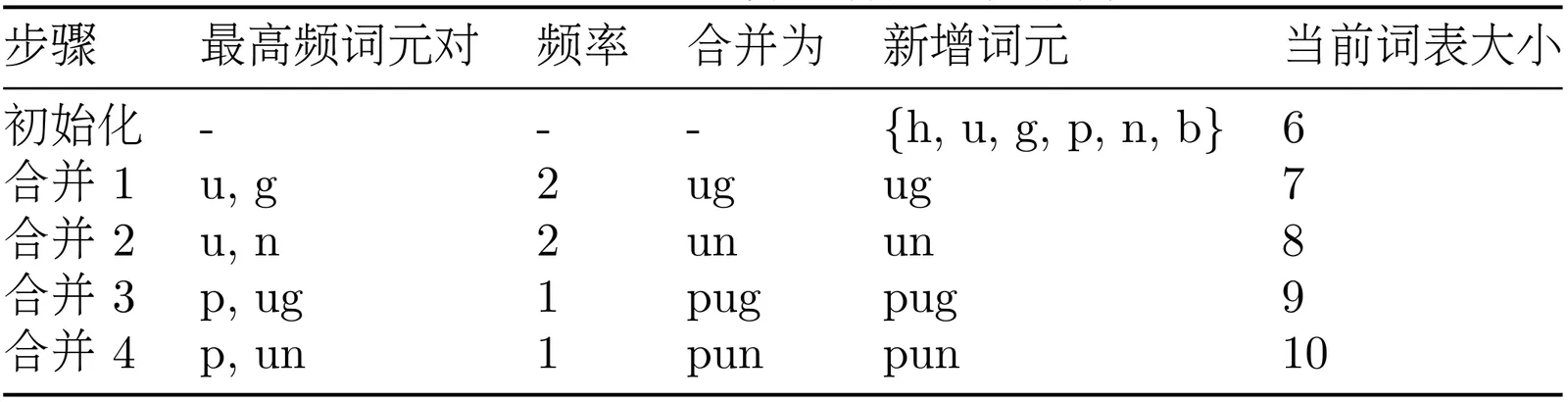
After training ends, when the vocabulary size reaches 10, we get new tokenization rules. Now, for an unseen word "bug," the tokenizer will first check if "bug" is in the vocabulary and find it's not; then check "bu" and find it's not; finally check "b" and "ug," find both are in, and thus split it into ['b', 'ug'].
Below we use a simple Python code to simulate the above process:
import re, collections

def get_stats(vocab):
    """Count token pair frequencies"""
    pairs = collections.defaultdict(int)
    for word, freq in vocab.items():
        symbols = word.split()
        for i in range(len(symbols)-1):
            pairs[symbols[i],symbols[i+1]] += freq
    return pairs

def merge_vocab(pair, v_in):
    """Merge token pairs"""
    v_out = {}
    bigram = re.escape(' '.join(pair))
    p = re.compile(r'(?<!\S)' + bigram + r'(?!\S)')
    for word in v_in:
        w_out = p.sub(''.join(pair), word)
        v_out[w_out] = v_in[word]
    return v_out

# Prepare corpus, add </w> at the end of each word to indicate ending, and split characters
vocab = {'h u g </w>': 1, 'p u g </w>': 1, 'p u n </w>': 1, 'b u n </w>': 1}
num_merges = 4 # Set number of merges

for i in range(num_merges):
    pairs = get_stats(vocab)
    if not pairs:
        break
    best = max(pairs, key=pairs.get)
    vocab = merge_vocab(best, vocab)
    print(f"Merge {i+1}: {best} -> {''.join(best)}")
    print(f"New vocabulary (partial): {list(vocab.keys())}")
    print("-" * 20)

>>>
Merge 1: ('u', 'g') -> ug
New vocabulary (partial): ['h ug </w>', 'p ug </w>', 'p u n </w>', 'b u n </w>']
--------------------
Merge 2: ('ug', '</w>') -> ug</w>
New vocabulary (partial): ['h ug</w>', 'p ug</w>', 'p u n </w>', 'b u n </w>']
--------------------
Merge 3: ('u', 'n') -> un
New vocabulary (partial): ['h ug</w>', 'p ug</w>', 'p un </w>', 'b un </w>']
--------------------
Merge 4: ('un', '</w>') -> un</w>
New vocabulary (partial): ['h ug</w>', 'p ug</w>', 'p un</w>', 'b un</w>']
--------------------
This code clearly demonstrates how the BPE algorithm gradually builds and expands the vocabulary by iteratively merging the highest-frequency adjacent token pairs.
Many subsequent algorithms are optimizations based on BPE. Among them, WordPiece and SentencePiece developed by Google are the two most influential.
- WordPiece: The algorithm adopted by Google's BERT model<sup>[7]</sup>. It is very similar to BPE, but the criterion for merging tokens is not "highest frequency" but "maximizing the improvement of the corpus's language model probability." Simply put, it prioritizes merging token pairs that can maximize the "fluency" improvement of the entire corpus.
- SentencePiece: An open-source tokenization tool by Google<sup>[8]</sup>, adopted by the Llama series models. Its biggest feature is treating spaces as ordinary characters (usually represented by underscore
_). This makes the tokenization and decoding process completely reversible and independent of specific languages (for example, it doesn't need to know that Chinese doesn't use spaces for word segmentation).
3.2.2.3 Significance of Tokenizers for Developers
Understanding the details of tokenization algorithms is not the goal, but as an agent developer, understanding the actual impact of tokenizers is important, as it directly relates to agent performance, cost, and stability:
- Context Window Limitation: The model's context window (such as 8K, 128K) is calculated in Token count, not character count or word count. The same text may have vastly different Token counts in different languages (such as Chinese and English) or with different tokenizers. Precisely managing input length and avoiding exceeding context limits is the foundation for building long-term memory agents.
- API Cost: Most model APIs charge based on Token count. Understanding how your text will be tokenized is a key step in estimating and controlling agent operating costs.
- Model Performance Anomalies: Sometimes strange model behavior stems from tokenization. For example, the model might be good at calculating
2 + 2but might make mistakes with2+2(without spaces) because the latter might be treated by the tokenizer as an independent, uncommon token. Similarly, a word with different capitalization of the first letter might be split into completely different Token sequences, affecting the model's understanding. Considering these "traps" when designing prompts and parsing model outputs helps improve agent robustness.
3.2.3 Calling Open-Source Large Language Models
In Chapter 1 of this book, we interacted with large language models through APIs to drive our agents. This is a fast and convenient method, but not the only one. For many scenarios requiring sensitive data processing, offline operation, or fine cost control, deploying large language models directly locally becomes crucial.
Hugging Face Transformers is a powerful open-source library that provides standardized interfaces to load and use tens of thousands of pre-trained models. We will use it to complete this practice.
Environment Configuration and Model Selection: To ensure most readers can run smoothly on personal computers, we deliberately chose a small-scale but powerful model: Qwen/Qwen1.5-0.5B-Chat. This is a dialogue model with about 500 million parameters open-sourced by Alibaba DAMO Academy. It's small in size, excellent in performance, and very suitable for introductory learning and local deployment.
First, please ensure you have installed the necessary libraries:
pip install transformers torchIn the transformers library, we typically use the AutoModelForCausalLM and AutoTokenizer classes to automatically load weights and tokenizers matching the model. The following code will automatically download required model files and tokenizer configurations from Hugging Face Hub, which may take some time depending on your network speed.
import torch
from transformers import AutoModelForCausalLM, AutoTokenizer

# Specify model ID
model_id = "Qwen/Qwen1.5-0.5B-Chat"

# Set device, prioritize GPU
device = "cuda" if torch.cuda.is_available() else "cpu"
print(f"Using device: {device}")

# Load tokenizer
tokenizer = AutoTokenizer.from_pretrained(model_id)

# Load model and move it to specified device
model = AutoModelForCausalLM.from_pretrained(model_id).to(device)

print("Model and tokenizer loaded!")
Let's create a dialogue prompt. The Qwen1.5-Chat model follows a specific dialogue template. Then, we can use the tokenizer loaded in the previous step to convert the text prompt into numerical IDs (i.e., Token IDs) that the model can understand.
# Prepare dialogue input
messages = [
    {"role": "system", "content": "You are a helpful assistant."},
    {"role": "user", "content": "Hello, please introduce yourself."}
]

# Use tokenizer's template to format input
text = tokenizer.apply_chat_template(
    messages,
    tokenize=False,
    add_generation_prompt=True
)

# Encode input text
model_inputs = tokenizer([text], return_tensors="pt").to(device)

print("Encoded input text:")
print(model_inputs)

>>>
{'input_ids': tensor([[151644, 8948, 198, 2610, 525, 264,  10950, 17847, 13,151645, 198, 151644, 872, 198, 108386, 37945, 100157, 107828,1773, 151645, 198, 151644, 77091, 198]], device='cuda:0'), 'attention_mask': tensor([[1, 1, 1, 1, 1, 1, 1, 1, 1, 1, 1, 1, 1, 1, 1, 1, 1, 1, 1, 1, 1, 1, 1, 1]],
       device='cuda:0')}
Now we can call the model's generate() method to generate an answer. The model will output a series of Token IDs representing its answer.
Finally, we need to use the tokenizer's decode() method to translate these numerical IDs back into human-readable text.
# Use model to generate answer
# max_new_tokens controls the maximum number of new Tokens the model can generate
generated_ids = model.generate(
    model_inputs.input_ids,
    max_new_tokens=512
)

# Truncate the input part from generated Token IDs
# This way we only decode the newly generated part by the model
generated_ids = [
    output_ids[len(input_ids):] for input_ids, output_ids in zip(model_inputs.input_ids, generated_ids)
]

# Decode generated Token IDs
response = tokenizer.batch_decode(generated_ids, skip_special_tokens=True)[0]

print("\nModel's answer:")
print(response)

>>>
My name is Tongyi Qianwen, a pre-trained language model developed by Alibaba Cloud. I can answer questions, create text, express opinions, and write code. My main functions are to provide help in multiple fields, including but not limited to: language understanding, text generation, machine translation, question-answering systems, etc. Is there anything I can help you with?
After running all the code, you will see the model-generated introduction about the Qwen model on your local computer. Congratulations, you have successfully deployed and run an open-source large language model locally!
3.2.4 Model Selection
In the previous section, we successfully ran a small open-source language model locally. This naturally raises a crucial question for agent developers: in the current context of hundreds of blooming models, how should we choose the most suitable model for specific tasks?
Choosing a language model is not simply pursuing "the biggest, the strongest" but a decision-making process balancing performance, cost, speed, and deployment methods. This section will first organize several key considerations for model selection, then review current mainstream closed-source and open-source models.
Since large language model technology is in a stage of rapid development, with new models and versions emerging constantly and extremely fast iteration, this section strives to provide an overview of current mainstream models and selection considerations when written, but readers should note that specific model versions and performance data mentioned may change over time, and only some work is listed, not comprehensively. We focus more on introducing core technical characteristics, development trends, and general selection principles in agent development.
3.2.4.1 Key Considerations for Model Selection
When choosing a large language model for your agent, you can comprehensively evaluate from the following dimensions:
- Performance and Capability: This is the core consideration. Different models excel at different tasks; some are good at logical reasoning and code generation, while others are better at creative writing or multilingual translation. You can refer to some public benchmark leaderboards (such as LMSys Chatbot Arena Leaderboard) to evaluate models' comprehensive capabilities.
- Cost: For closed-source models, cost mainly manifests in API call fees, usually charged by Token count. For open-source models, cost manifests in hardware (GPU, memory) and operations required for local deployment. Choices need to be made based on application's expected usage and budget.
- Speed (Latency): For agents requiring real-time interaction (such as customer service, game NPCs), model response speed is crucial. Some lightweight or optimized models (such as GPT-3.5 Turbo, Claude 3.5 Sonnet) perform better in latency.
- Context Window: The upper limit of Token count the model can process at once. For agents needing to understand long documents, analyze code repositories, or maintain long-term conversation memory, choosing a model with a larger context window (such as 128K Tokens or higher) is necessary.
- Deployment Method: Using APIs is simplest and most convenient, but data needs to be sent to third parties and is subject to service provider terms. Local deployment can ensure data privacy and highest degree of autonomy, but has higher technical and hardware requirements.
- Ecosystem and Toolchain: A model's popularity also determines the maturity of its surrounding ecosystem. Mainstream models usually have richer community support, tutorials, pre-trained models, fine-tuning tools, and compatible development frameworks (such as LangChain, LlamaIndex, Hugging Face Transformers), which can greatly accelerate development and reduce difficulty. Choosing a model with an active community and complete toolchain makes it easier to find solutions and resources when encountering problems.
- Fine-tunability and Customization: For agents needing to process domain-specific data or perform specific tasks, model fine-tuning capability is crucial. Some models provide convenient fine-tuning interfaces and tools, allowing developers to customize training using their own datasets, significantly improving model performance and accuracy in specific scenarios. Open-source models usually provide greater flexibility in this regard.
- Safety and Ethics: With widespread application of large language models, their potential safety risks and ethical issues are increasingly prominent. When choosing models, consider their performance in bias, toxicity, hallucination, etc., and service providers' or open-source communities' investment in model safety and responsible AI. For applications facing the public or involving sensitive information, model safety and ethical compliance are considerations that cannot be ignored.
3.2.4.2 Overview of Closed-Source Models
Closed-source models usually represent the cutting edge of current AI technology and provide stable, easy-to-use API services, making them the first choice for building high-performance agents.
- OpenAI GPT Series: From GPT-3 that opened the large model era, to ChatGPT that introduced RLHF (Reinforcement Learning from Human Feedback) and achieved alignment with human intent, to GPT-4 that opened the multimodal era, OpenAI continues to lead industry development. The latest GPT-5 further elevates multimodal capabilities and general intelligence to new heights, seamlessly processing text, audio, and image inputs and generating corresponding outputs, with significantly improved response speed and naturalness, especially excelling in real-time voice dialogue.
- Google Gemini Series: Google DeepMind's Gemini series models are representatives of native multimodality, with the core feature of unified processing of multiple modalities including text, code, audio/video, and images, and advantages in massive information processing with ultra-long context windows. Gemini Ultra is its most powerful model, suitable for highly complex tasks; Gemini Pro is suitable for a wide range of tasks, providing high performance and efficiency; Gemini Nano is optimized for on-device deployment. The latest Gemini 2.5 series models, such as Gemini 2.5 Pro and Gemini 2.5 Flash, further improve reasoning capabilities and context windows, especially Gemini 2.5 Flash with faster inference speed and cost-effectiveness, suitable for scenarios requiring quick responses.
- Anthropic Claude Series: Anthropic is a company focused on AI safety and responsible AI. Its Claude series models have prioritized AI safety from the design stage, renowned for reliability in handling long documents, reducing harmful outputs, and following instructions, deeply favored by enterprise applications. Claude 3 series includes Claude 3 Opus (most intelligent, strongest performance), Claude 3 Sonnet (balanced choice of performance and speed), and Claude 3 Haiku (fastest, most compact model, suitable for near real-time interaction). The latest Claude 4 series models, such as Claude 4 Opus, have made significant progress in general intelligence, complex reasoning, and code generation, further improving capabilities in handling long contexts and multimodal tasks.
- Domestic Mainstream Models: China has emerged with many competitive closed-source models in the large language model field, represented by Baidu ERNIE Bot, Tencent Hunyuan, Huawei Pangu-α, iFlytek SparkDesk, and Moonshot AI. These domestic models have natural advantages in Chinese processing and deeply empower local industries.
3.2.4.3 Overview of Open-Source Models
Open-source models provide developers with the highest degree of flexibility, transparency, and autonomy, catalyzing a prosperous community ecosystem. They allow developers to deploy locally, perform customized fine-tuning, and have complete model control.
- Meta Llama Series: Meta's Llama series is an important milestone in open-source large language models. The series has become the foundation for many derivative projects and research with excellent comprehensive performance, open licensing agreements, and strong community support. Llama 4 series was released in April 2025, Meta's first models adopting Mixture of Experts (MoE) architecture, which significantly improves computational efficiency by only activating model parts needed to process specific tasks. The series includes three distinctly positioned models: Llama 4 Scout supports a 10 million token context window designed for long document analysis and mobile deployment. Llama 4 Maverick focuses on multimodal capabilities, excelling in coding, complex reasoning, and multilingual support. Llama 4 Behemoth outperforms competitors in multiple STEM benchmarks and is Meta's most powerful model currently.
- Mistral AI Series: Mistral AI from France is renowned for its "small size, high performance" model design. Its latest model Mistral Medium 3.1 was released in August 2025, with significantly improved accuracy and response speed in tasks such as code generation, STEM reasoning, and cross-domain Q&A, with benchmark performance superior to Claude Sonnet 3.7 and Llama 4 Maverick and other similar models. It has native multimodal capabilities, can simultaneously process mixed image and text inputs, and has a built-in "tone adaptation layer" to help enterprises more easily achieve brand-aligned outputs.
- Domestic Open-Source Forces: Domestic manufacturers and research institutions are also actively embracing open source, such as Alibaba's Qwen (Tongyi Qianwen) series and Tsinghua University's collaboration with Zhipu AI's ChatGLM series. They provide powerful Chinese capabilities and have built active communities around themselves.
For agent developers, closed-source models provide "out-of-the-box" convenience, while open-source models grant us "customization freedom." Understanding the characteristics and representative models of these two camps is the first step in making wise technical selections for our agent projects.