2.3 Marvin Minsky's Society of Mind
The exploration of symbolicism and ELIZA's practice jointly pointed to a problem: a single, centralized reasoning engine built through preset rules seems difficult to lead to true intelligence. No matter how large the rule base, the system always appears rigid and brittle when facing the ambiguity, complexity, and infinite changes of the real world. This dilemma prompted some top thinkers to reflect on the most fundamental design philosophy of artificial intelligence. Among them, Marvin Minsky did not continue trying to add more rules to a single reasoning core but proposed a revolutionary question in his book "The Society of Mind"<sup>[7]</sup>: "What magical trick makes us intelligent? The trick is that there is no trick. The power of intelligence stems from our vast diversity, not from any single, perfect principle."
2.3.1 Reflection on Single Holistic Intelligence Models
From the 1970s to the 1980s, the limitations of symbolicism became increasingly apparent. Although expert systems achieved success in highly vertical domains, they could not possess child-like common sense; although SHRDLU could perform excellently in a closed blocks world, it could not understand anything outside that world; although ELIZA could imitate conversation, it knew nothing about the conversation content itself. These systems all followed a top-down design approach: an omniscient central processor that processes information and makes decisions according to a unified set of logical rules.
Facing this universal failure, Minsky began to raise a series of fundamental questions:
- What is "understanding"? When we say we understand a story, is this a single ability? Or is it actually the result of dozens of different mental processes working together, such as visualization ability, logical reasoning ability, emotional resonance ability, and social relationship common sense?
- What is "common sense"? Is common sense a huge knowledge base containing millions of logical rules (as attempted by the Cyc project)? Or is it a distributed network woven from countless specific experiences and simple rule fragments?
- How should agents be built? Should we continue pursuing a perfect, unified logical system, or should we acknowledge that intelligence itself is an "imperfect" hodgepodge composed of many functionally different, even conflicting simple parts?
These questions directly addressed the core drawbacks of single holistic intelligence models. Such models attempt to solve all problems with a unified representation and reasoning mechanism, but this is far from how we observe natural intelligence (especially human intelligence) operating. Minsky believed that forcibly cramming diverse mental activities into a rigid logical framework was the root cause of early artificial intelligence research stagnation.
Based on this reflection, Minsky proposed a subversive conception: he no longer viewed the mind as a pyramid-like hierarchical structure but saw it as a flattened "society" full of interaction and collaboration.
2.3.2 Intelligence as Collaboration
In Minsky's theoretical framework, the definition of an agent differs from the modern agents we discussed in Chapter 1. Here, an agent refers to an extremely simple, specialized mental process that is itself "mindless." For example, a LINE-FINDER agent responsible for identifying lines, or a GRASP agent responsible for grasping.
These simple agents are organized to form more powerful Agencies. An agency is a group of agents working together to complete a more complex task. For example, a BUILD agency responsible for building blocks might be composed of multiple lower-level agents or agencies such as SEE, FIND, GET, and PUT. They influence each other through decentralized activation and inhibition signals, forming dynamic control flow.
Emergence is key to understanding the society of mind theory. Complex, purposeful intelligent behavior is not pre-planned by some high-level agent but spontaneously arises from local interactions among numerous simple bottom-level agents.
Let's use the classic "building a block tower" task as an example to illustrate this process, as shown in Figure 2.6. When a high-level goal (such as "I want to build a tower") appears, it activates a high-level agency called BUILD-TOWER.
- The
BUILD-TOWERagency doesn't know how to execute specific physical actions; its only role is to activate its subordinate agencies, such asBUILDER. - The
BUILDERagency is also very simple; it might only contain loop logic: as long as the tower isn't finished, activate theADD-BLOCKagency. - The
ADD-BLOCKagency is responsible for coordinating more specific subtasks; it sequentially activates three sub-agencies:FIND-BLOCK,GET-BLOCK, andPUT-ON-TOP. - Each sub-agency is composed of even lower-level agents. For example, the
GET-BLOCKagency activates theSEE-SHAPEagent in the visual system and theREACHandGRASPagents in the motor system.
In this process, no single agent or agency has a global plan for the entire task. GRASP is only responsible for grasping; it doesn't know what a tower is; BUILDER is only responsible for looping; it doesn't know how to control the arm. However, when this society composed of countless "mindless" agents interacts through simple activation and inhibition rules, a seemingly highly intelligent behavior—building a block tower—naturally emerges.
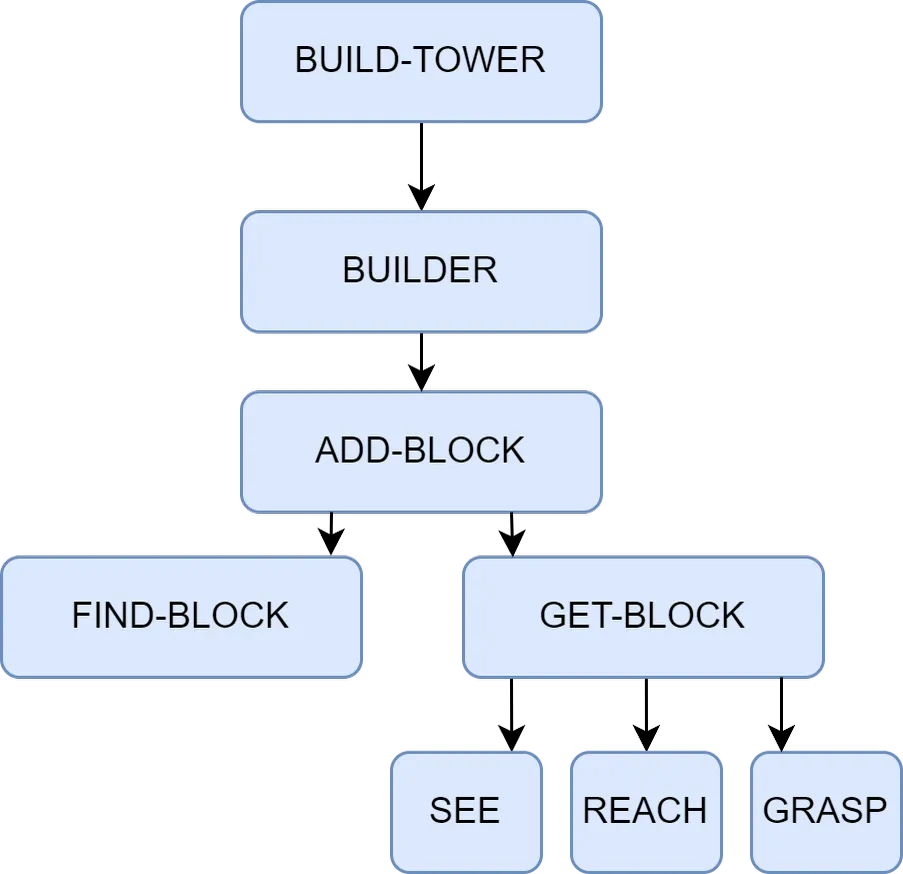
Figure 2.6 Schematic diagram of the emergence mechanism of block tower building behavior in the "society of mind"
2.3.3 Theoretical Inspiration for Multi-Agent Systems
The most far-reaching influence of the society of mind theory is that it provided an important conceptual foundation for Distributed Artificial Intelligence (DAI) and later Multi-Agent Systems (MAS). It prompted researchers to think:
If intelligence within a mind emerges through collaboration of numerous simple agents, then can more powerful "collective intelligence" also emerge through collaboration among multiple independent, physically separated computational entities (computers, robots)?
The raising of this question directly shifted research focus from "how to build an omnipotent single agent" to "how to design an efficiently collaborating agent group." Specifically, the society of mind directly inspired MAS research in the following aspects:
- Decentralized Control: The core of the theory is that there is no central controller. This idea was completely inherited by the MAS field, and how to design coordination mechanisms and task allocation strategies without central nodes became one of the core research topics of MAS.
- Emergent Computation: Solutions to complex problems can spontaneously arise from simple local interaction rules. This inspired numerous emergence-based algorithms in MAS, such as ant colony algorithms and particle swarm optimization, for solving complex optimization and search problems.
- Agent Sociality: Minsky's theory emphasized interactions between agents (activation, inhibition). The MAS field further expanded this, systematically studying communication languages between agents (such as ACL), interaction protocols (such as contract nets), negotiation strategies, trust models, and even organizational structures, thereby constructing true computational societies.
It can be said that Minsky's "society of mind" theory provided an important analytical framework for AI researchers to understand the internal structure of "collective intelligence." It provided later researchers with a completely new perspective to explore complex systems composed of independent, autonomous, socially capable computational agents, formally opening the prelude to multi-agent system research.