1.4 Collaboration Modes of Agent Applications
In the previous section, we gained a deep understanding of the internal operating loop of an agent by building one ourselves. However, in broader application scenarios, our role is increasingly transforming into users and collaborators. Based on the agent's role in tasks and degree of autonomy, its collaboration modes are mainly divided into two types: one is as an efficient tool deeply integrated into our workflow; the other is as an autonomous collaborator working with other agents to complete complex goals.
1.4.1 Agents as Developer Tools
In this mode, agents are deeply integrated into developers' workflows as powerful auxiliary tools. They enhance rather than replace the developer's role, automating tedious, repetitive tasks so developers can focus more on creative core work. This human-machine collaboration approach greatly improves the efficiency and quality of software development.
Currently, the market has seen the emergence of multiple excellent AI programming assistance tools. While they all improve development efficiency, they differ in implementation paths and functional focus:
- GitHub Copilot: As one of the most influential products in this field, Copilot was jointly developed by GitHub and OpenAI. It is deeply integrated into mainstream editors such as Visual Studio Code and is renowned for its powerful code auto-completion capabilities. When developers write code, Copilot can provide real-time suggestions for entire lines or even entire function blocks. In recent years, it has also expanded conversational programming capabilities through Copilot Chat, allowing developers to solve programming problems through chat within the editor.
- Claude Code: Claude Code is an AI programming assistant developed by Anthropic, designed to help developers efficiently complete coding tasks in the terminal through natural language instructions. It can understand complete codebase structures, perform operations such as code editing, testing, and debugging, and supports full-process development from describing functionality to code implementation. Claude Code also provides a headless mode suitable for CI, pre-commit hooks, build scripts, and other automation scenarios, providing developers with a powerful command-line programming experience.
- Trae: As an emerging AI programming tool, Trae focuses on providing developers with intelligent code generation and optimization services. It analyzes code patterns through deep learning technology and can provide developers with precise code suggestions and automated refactoring solutions. Trae's distinctive feature is its lightweight design and fast response capability, particularly suitable for scenarios requiring frequent iteration and rapid prototyping.
- Cursor: Unlike the above tools that mainly exist as plugins or integrated features, Cursor has chosen a more integrated path—it is itself an AI-native code editor. Rather than adding AI functionality to existing editors, it made AI interaction a core feature from the design stage. In addition to top-tier code generation and chat capabilities, it emphasizes letting AI understand the context of the entire codebase, thereby achieving deeper Q&A, refactoring, and debugging.
Of course, there are many other excellent tools not listed here, but they all point to a clear trend: AI is deeply integrating into the entire software development lifecycle, profoundly reshaping the efficiency boundaries and development paradigms of software engineering by building efficient human-machine collaborative workflows.
1.4.2 Agents as Autonomous Collaborators
Unlike serving as tools to assist humans, the second interaction mode elevates the automation level of agents to an entirely new level: autonomous collaborators. In this mode, we no longer guide AI step-by-step through every action but delegate a high-level goal to it. The agent, like a true project team member, independently plans, reasons, executes, and reflects until finally delivering results. This transformation from assistant to collaborator has brought LLM agents deeper into public view. It marks the evolution of our relationship with AI from "command-execute" to "goal-delegate." Agents are no longer passive tools but active goal pursuers.
Currently, approaches to achieving this autonomous collaboration are flourishing, with numerous excellent frameworks and products emerging, from early BabyAGI and AutoGPT to now more mature frameworks like CrewAI, AutoGen, MetaGPT, and LangGraph, collectively driving rapid development in this field. Although specific implementations vary greatly, their architectural paradigms can be roughly summarized into several mainstream directions:
- Single-Agent Autonomous Loop: This is an early typical paradigm, represented by models like AgentGPT. Its core is a general agent that continuously self-prompts and iterates through a "think-plan-execute-reflect" closed loop to complete an open-ended high-level goal.
- Multi-Agent Collaboration: This is currently the most mainstream exploration direction, aiming to solve complex problems by simulating human team collaboration modes. It can be further subdivided into different modes: Role-Playing Dialogue: Like the CAMEL framework, which assigns clear roles and communication protocols to two agents (for example, "programmer" and "product manager"), allowing them to collaboratively complete tasks in a structured dialogue. Organized Workflow: Like MetaGPT and CrewAI, which simulate a "virtual team" with clear division of labor (such as a software company or consulting group). Each agent has preset responsibilities and workflows (SOPs), collaborating in a hierarchical or sequential manner to produce high-quality complex outputs (such as complete codebases or research reports). AutoGen and AgentScope provide more flexible dialogue modes, allowing developers to customize complex interaction networks between agents.
- Advanced Control Flow Architecture: Frameworks such as LangGraph focus more on providing agents with more powerful underlying engineering foundations. They model the agent's execution process as a state graph, enabling more flexible and reliable implementation of complex processes such as loops, branches, backtracking, and human intervention.
These different architectural paradigms collectively drive autonomous agents from theoretical concepts toward broader practical applications, enabling them to handle increasingly complex real-world tasks. In our subsequent chapters, we will also experience the differences and advantages between different types of frameworks.
1.4.3 Differences Between Workflow and Agent
After understanding the two modes of agents as "tools" and "collaborators," it is necessary to discuss the differences between Workflow and Agent. Although both aim to achieve task automation, their underlying logic, core characteristics, and applicable scenarios are fundamentally different.
Simply put, Workflow makes AI execute instructions step by step, while Agent gives AI freedom to autonomously achieve goals.
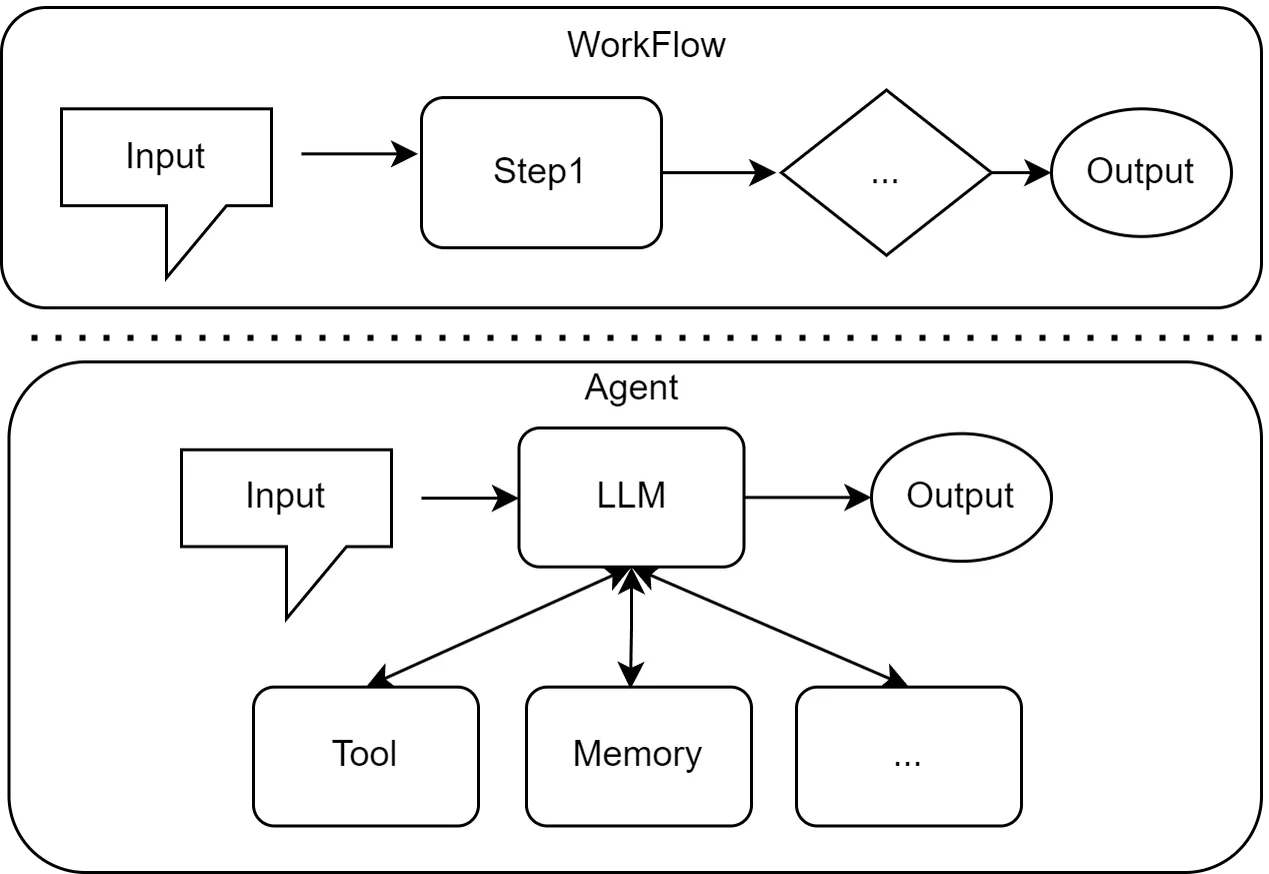
Figure 1.6 Differences between Workflow and Agent
As shown in Figure 1.6, workflow is a traditional automation paradigm whose core is pre-defined, structured orchestration of a series of tasks or steps. It is essentially a precise, static flowchart that specifies which operations to execute under what conditions and in what order. A typical case: a company's expense reimbursement approval process. Employee submits reimbursement form (trigger) -> If amount is less than 500 yuan, directly approved by department manager -> If amount is greater than 500 yuan, first approved by department manager, then forwarded to CFO for approval -> After approval, notify finance department to make payment. Every step and every judgment condition of the entire process is precisely preset.
Unlike workflows, agents based on large language models are autonomous, goal-oriented systems. They not only execute preset instructions but can also understand the environment to a certain extent, reason, formulate plans, and dynamically take actions to achieve final goals. LLMs play the role of the "brain" in this process. A typical example is the intelligent travel assistant we wrote in Section 1.3. When we give it a new instruction, for example: "Hello, please help me check today's weather in Beijing, and then recommend a suitable tourist attraction based on the weather." Its processing fully demonstrates its autonomy:
- Planning and Tool Invocation: The agent first breaks down the task into two steps: ① Query weather; ② Recommend attractions based on weather. Then, it autonomously selects and calls the "weather query API," passing "Beijing" as a parameter.
- Reasoning and Decision-Making: Suppose the API returns "sunny, light breeze." The agent's LLM brain will reason based on this information: "Sunny days are suitable for outdoor activities." Then, based on this judgment, it will filter outdoor attractions in Beijing from its knowledge base or through search engine tools, such as the Forbidden City, Summer Palace, Temple of Heaven Park, etc.
- Generate Results: Finally, the agent will synthesize the information and provide a complete, humanized answer: "Today's weather in Beijing is sunny with a light breeze, very suitable for outdoor activities. I recommend you visit the Summer Palace, where you can boat on Kunming Lake and enjoy the beautiful royal garden scenery."
In this process, there are no hard-coded rules like if weather=sunny then recommend Summer Palace. If the weather is "rainy," the agent will autonomously reason and recommend indoor venues such as the National Museum or Capital Museum. This ability to dynamically reason and make decisions based on real-time information is the core value of agents.