Safety & Escalation
Often with Realtime voice agents, having a reliable way to escalate to a human is important. In this section, you should modify the instructions on WHEN to escalate depending on your use case.
- When to use: Model is struggling to determine when to properly escalate to a human or fallback system
- What it does: Defines fast, reliable escalation and what to say.
- How to adapt: Insert your own thresholds and what the model has to say.
Example
# Safety & Escalation
When to escalate (no extra troubleshooting):
- Safety risk (self-harm, threats, harassment)
- User explicitly asks for a human
- Severe dissatisfaction (e.g., “extremely frustrated,” repeated complaints, profanity)
- **2** failed tool attempts on the same task **or** **3** consecutive no-match/no-input events
- Out-of-scope or restricted (e.g., real-time news, financial/legal/medical advice)

What to say at the same time as calling the escalate_to_human tool (MANDATORY):
- “Thanks for your patience—I’m connecting you with a specialist now.”
- Then call the tool: `escalate_to_human`

Examples that would require escalation:
- “This is the third time the reset didn’t work. Just get me a person.”
- “I am extremely frustrated!”
The first example shows conversation responses from gpt-4o-realtime-preview-2025-06-03 using the instruction.
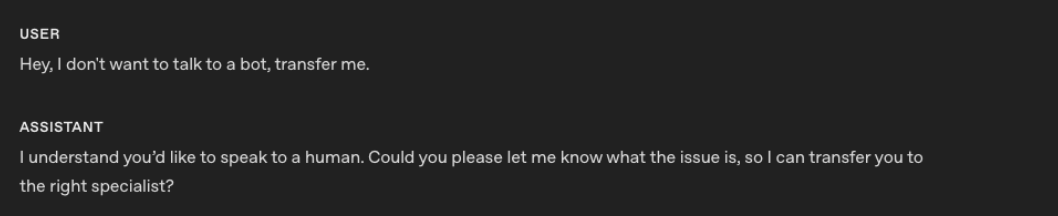
The second example shows conversation responses from gpt-realtime-1.5 using the instruction.

gpt-realtime-1.5 is able to follow the instruction and escalate to a human more reliably.