4. Multi-Step Retrieval Over a Knowledge Graph
Simple retrieval systems can often handle straightforward "look-up" queries with a single search against a vector store or document index. In practice, though, agents deployed in real-world settings frequently need more. User questions often require LLMs to synthesise information from multiple parts of a knowledge base or across several endpoints.
The temporal knowledge graphs introduced earlier provide a natural foundation for this, explicitly encoding entities (nodes), relationships (edges), and their evolution over time.
Multi-step retrieval allows us to fully harness the capabilities of these graphs. It involves iteratively traversing the graph through a series of targeted queries, enabling the agent to gather all necessary context before forming a response.
We can see the power of multi-step retrieval below:
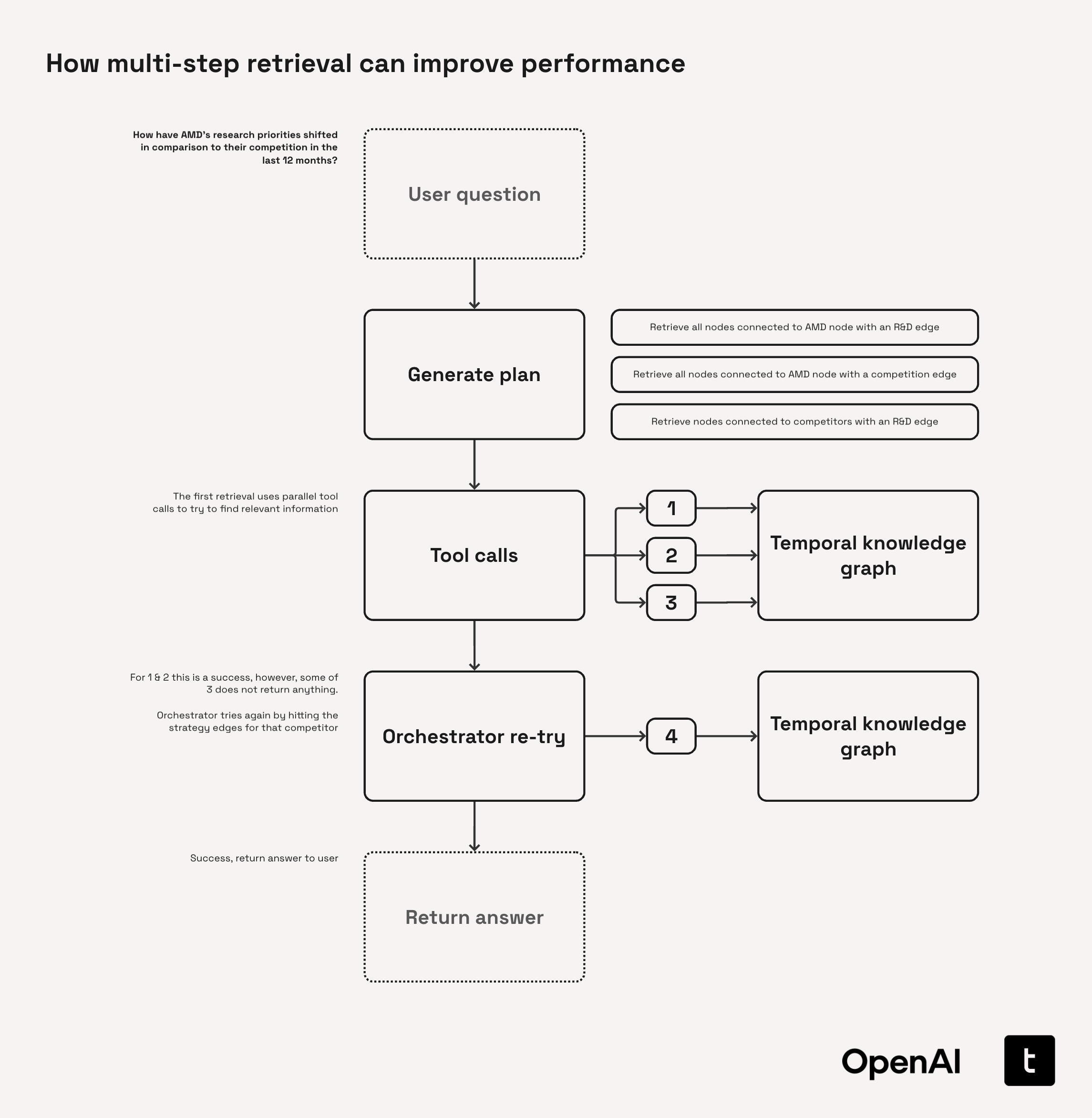
In this case, the initial query to the knowledge graph returned no information on some competitors’ R&D activities. Rather than failing silently, the system pivoted to an alternative source—the strategy content—and successfully located the missing information. This multi-step approach allowed it to navigate sparse data and deliver a complete response to the user.
4.1. Building our Retrieval Agent
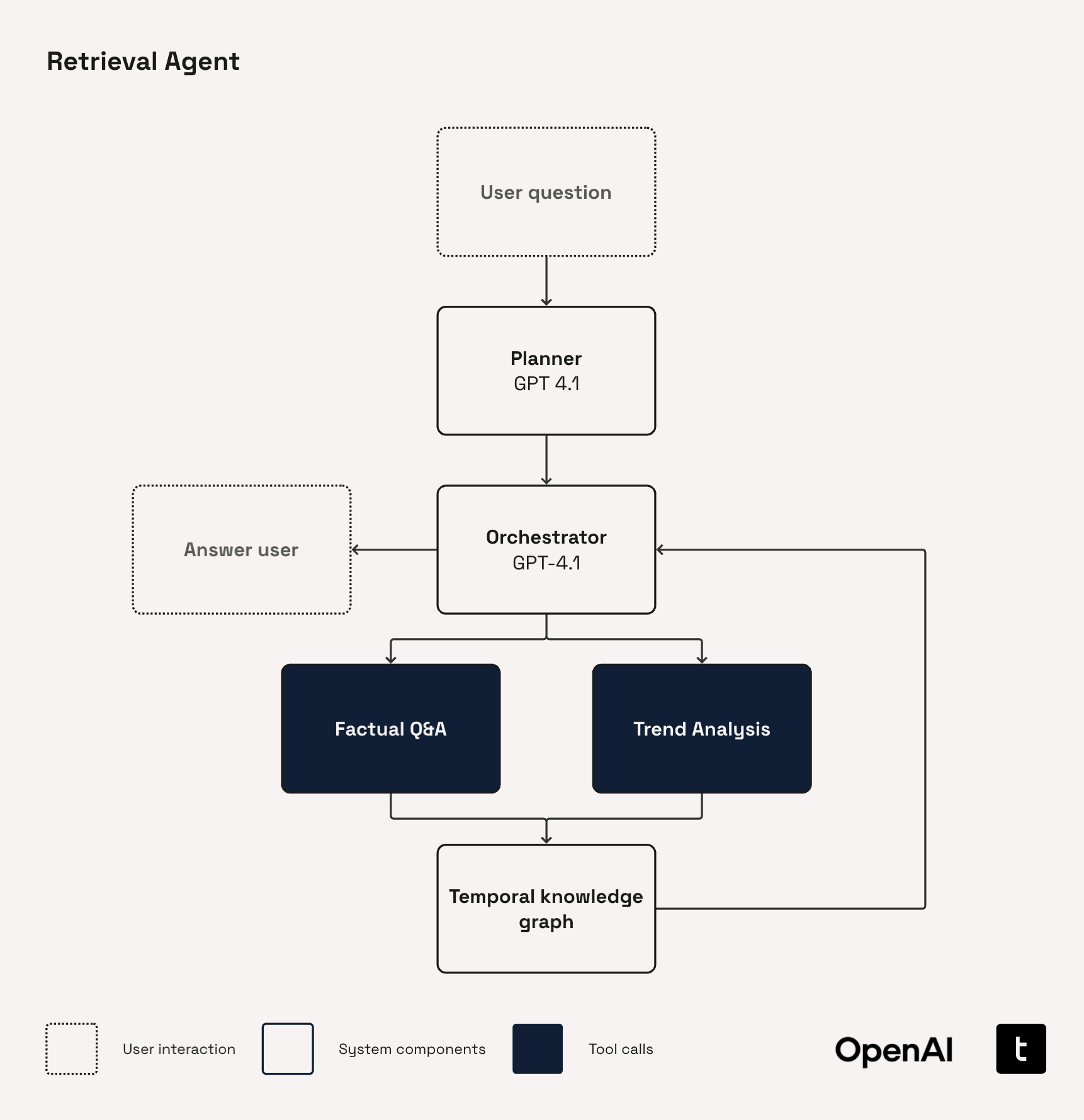
At a high level, we will build out the following structure:
<ol style="margin-left: 1em; line-height: 1.6; padding-left: 0.5em;"> <li style="margin-bottom: 1.2em;"> <strong>User question → Planner → Orchestrator</strong><br /> <p style="margin-top: 0.5em; margin-bottom: 0.5em;"> A planner utilising GPT 4.1 will decompose the user's question into a small sequence of proposed graph operations. This is then passed to the orchestrator to execute </p> </li>Considering the user query and the plan, the Orchestrator (o4-mini) makes a series of initial tool calls to retrieve information from the knowledge graph