Crawl harness
Synthetic single-turn evaluations
CRAWL is a repeatable single-turn evaluation harness for GPT Live voice agents. It turns scenario text into reusable caller audio, sends one spoken request to the assistant, and grades the spoken response, delegation and tool behavior, and final application state.
Use CRAWL to catch regressions and compare prompts, tools, models, or configurations with consistent inputs. It provides broad functional coverage without requiring recorded audio or a multi-turn caller simulator. Its CLI, input preparation, session lifecycle, and batch execution remain owned by CRAWL; it does not import WALK.
For setup, model access, and source-versus-wheel commands, see setup. The commands below run from the harness directory. Live commands incur API usage; start with one example.
What you can evaluate
CRAWL evaluates how a voice agent handles one spoken request, including:
- Whether it gives a correct and relevant spoken response.
- Whether it delegates appropriately and selects the correct tools and arguments.
- Whether tools execute in the expected order and produce the correct final application state.
- Whether it handles prior context, in-request corrections, missing information, and unauthorized actions appropriately.
- Whether it confirms an action only after the underlying tool succeeds.
- Response timing and interruption behavior during the caller's request.
A single-turn evaluation does not establish multi-turn behaviors such as yielding, backchannels, follow-up clarification, or procedure adherence. Use RUN for those conversational behaviors.
How it works
- The harness loads a scenario containing a caller request and evaluator-only expectations.
- A text-to-speech model synthesizes the request into reusable caller audio.
- The audio is streamed in paced PCM chunks to the GPT Live assistant.
- The assistant can delegate to its reasoning backend, which selects tools; application code executes its functions and returns their results.
- The harness captures the assistant response, tool activity, and final application state, grades the observed outcome, and saves the supporting artifacts.
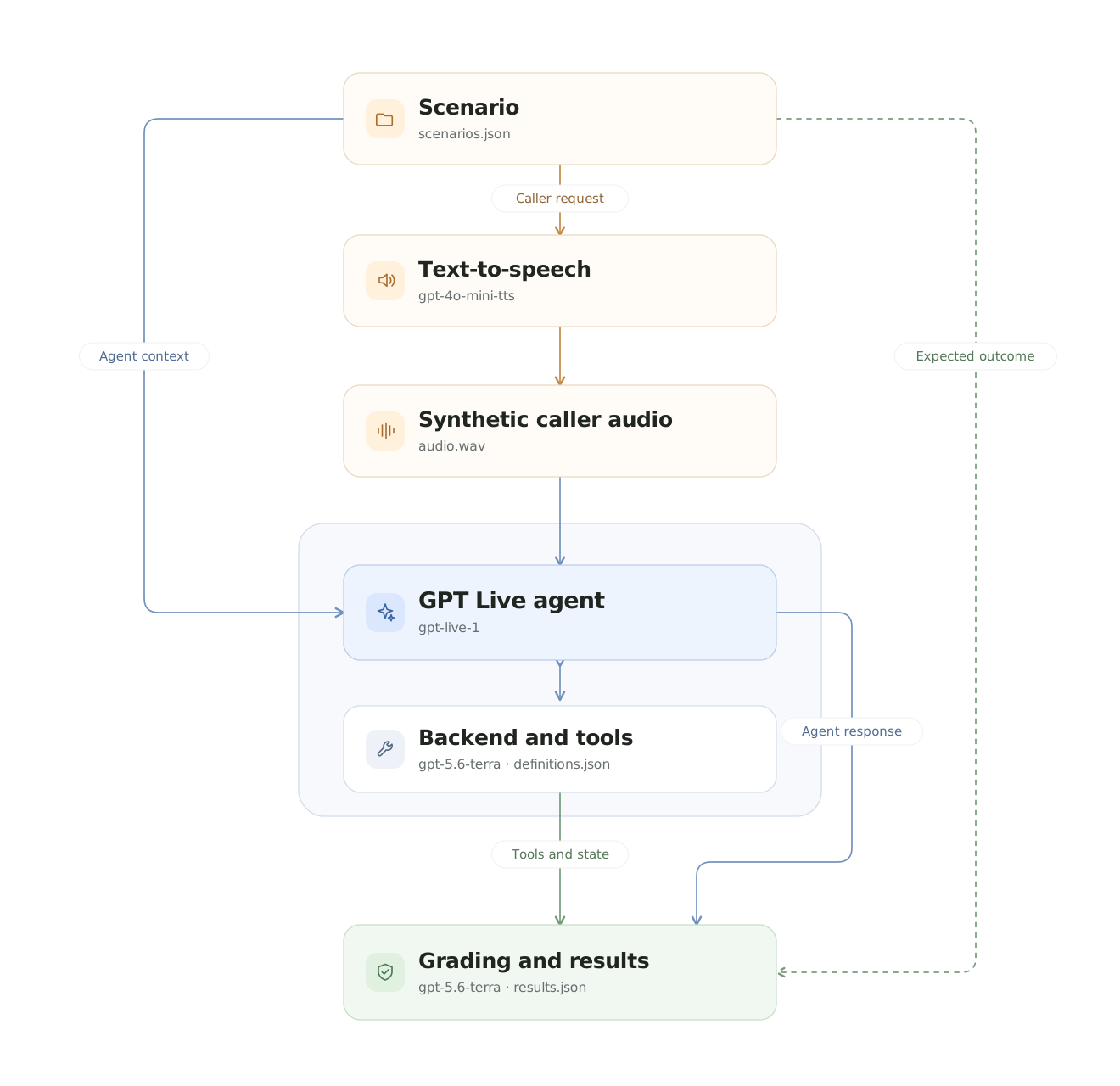
Model identifiers shown are repository defaults and can be overridden at runtime. Expected outcomes from scenarios.json remain evaluator-only.
Response completion
V3 has no authoritative turn or audio-done event. CRAWL waits for caller input to finish, delegated work to complete, settled speech-backed transcript turns, and the quiet tail. Continuously queued silent audio does not block completion.
After delegation, a new spoken turn must start after returned content becomes available. An acknowledgment already underway or captioned at that point does not qualify; a valid answer sharing its caption group can therefore time out. Backend completion and context-append acknowledgments alone are insufficient. --response-timeout-seconds defaults to 30 seconds from caller-input completion and does not restart for delegation or returned content. A timeout is recorded as response_timeout, with available audio and events retained.
Inputs
CRAWL reads versioned JSON scenarios from data/scenarios.json. Each scenario can provide:
- The caller request text that will be synthesized into audio.
- Optional authorized context from earlier text turns.
- The authorized initial application state.
- Evaluator-owned expectations for the answer, delegation, tool calls, and final state.
Only the synthesized caller audio and authorized context are provided to the assistant. Expected answers, tool arguments, and golden state remain private to the evaluator. See Data for the complete scenario structure.
Outputs
The paths below describe a source checkout. Installed wheels write to ./results/crawl/ by default. See installation and path rules for overrides, environment-file selection, and optional playback.
A completed scenario produces the following supporting artifacts:
crawl_harness/results/crawl_live_<timestamp>/
├── audio/
│   └── restaurant_003/
│       ├── input.wav
│       ├── output.wav
│       ├── conversation.wav
│       └── conversation.transcript.txt
├── events/
│   └── restaurant_003.jsonl
├── transcripts/
│   └── restaurant_003.json
└── results.json| File | Contents |
|---|---|
results.json | Task, audio, and consumption metrics plus the shared outcome assessment and single-turn observability summary. |
input.wav | Exact synthetic caller audio sent to GPT Live. |
output.wav | Captured assistant audio. |
conversation.wav | Timeline-aligned stereo conversation. |
conversation.transcript.txt | Readable caller/assistant transcript. |
events/*.jsonl | Session, audio-timing, delegation, tool, and evaluator events; raw audio payloads are removed. |
transcripts/*.json | Detailed tool execution, final state, deterministic checks, and semantic grades. |
Transcripts, tool arguments, and application state are not privacy-redacted. Provider, input, or grading failures can leave only some of these artifacts. Check the per-scenario status and error in results.json; do not infer success from the process exit code or an existing recording.
Run the evaluation
Start with one representative scenario:
uv run crawl-eval --example restaurant_003After verifying it, run the complete dataset (additional API usage):
uv run crawl-evalCommon options:
--max-examples 5limits the number of scenarios.--verboseprints audio events, transcripts, tool calls, and individual results.--listenplays the caller on the left stereo channel and the assistant on the right.--refresh-audioregenerates cached caller speech.--concurrency 4runs independent scenarios in parallel.--assistant clientevaluates the application-managed assistant instead of the default OpenAI-managed Responses assistant.--assistant-endpoint wss://agent.example.com/ws/assistantselects a separately running client service when combined with--assistant client; it requires a dedicated service token. See service setup.--offline --no-real-timechecks the pipeline without calling a model.
CRAWL saves generated caller speech under .audio_cache/ and reuses the same WAV on later runs. Changing the scenario text, TTS model, voice, or sample rate automatically creates a new recording.
Each concurrent worker receives a separate GPT Live session, application executor, initial state, and artifact directory. Concurrency is limited to 1–8; begin with a low value appropriate for your API project’s rate limits. Do not combine --listen with concurrency greater than one.
Verify offline
For a quick deterministic offline check of one scenario:
uv run crawl-eval \
  --offline \
  --no-real-time \
  --example restaurant_003
Offline results exercise audio handling, tool execution, artifacts, and deterministic checks for the supplied fixtures. They do not measure a live model or a real semantic judge.
Use uv run crawl-eval --help for all options.
Metrics and grading
CRAWL exports the same metric groups as WALK and RUN:
| Group | Metrics |
|---|---|
| Task | task_completed, semantic_quality, tool_accuracy, tool_calls, delegation_accuracy, delegations, turns. |
| Audio | response_rate, response_latency_ms, interruption_rate, speaking_duration_ms, floor_hold_silence_ms. |
| Consumption | Frontend Live duration and the available backend token breakdown. |
Detailed artifacts retain yielding and backchannel diagnostics without adding them to the primary single-run metric contract. Assistant interruption can still be measured during the single caller utterance.
Deterministic dimensions include:
run_validity
delegation_decision
tool_selection
parameter_accuracy
tool_execution
final_state
clarification_behavior
grounded_relay_order
Applicable live semantic rubrics use the same definitions as WALK and RUN: task_understanding, context_fidelity, clarification_quality, and grounded_communication. conversational_coherence applies only to multi-turn scenarios. Inapplicable rubrics remain unscored. Live evaluation makes one to three semantic-judge calls per scenario.
Each applicable dimension receives a binary verdict and an individual score of 0, 0.25, 0.5, 0.75, or 1 reflecting error severity. metrics.task.semantic_quality reports its mean score and applicable dimensions for each scenario. The run summary contains only execution counts. Only task understanding contributes to the semantic task-completion decision; other dimension verdicts remain diagnostic. Partial credit never overrides task completion, authorized actions, expected tool behavior, or verified application state. Offline runs leave semantic-quality scores null.
Every result uses the same outcome-assessment contract as WALK and RUN: assistant response, verified application state, delegation, authorized actions, tool-backed state changes, grounded relay, and optional semantic completion. Because CRAWL evaluates one specific capability, its expected tool name, arguments, and execution form an explicit required check. Observability reports synthetic audio input, delegation, actual tool calls, and deterministic/semantic grade statuses; it does not invent multi-turn floor or agenda diagnostics.
A single request does not demonstrate yielding, backchannel behavior, or multi-turn procedure adherence. Detailed deterministic checks, semantic verdicts, fractional dimension scores, and supporting rationales remain available in the transcript artifacts alongside the compact semantic-quality summary.
Adapt the harness
Configuration
config.toml controls the module:
[dataset]
path = "data/scenarios.json"

[execution]
concurrency = 1
max_examples = 0
verbose = false
response_timeout_seconds = 30.0

[audio]
chunk_ms = 20
sample_rate_hz = 24000
real_time = true

[assistant]
mode = "responses"
endpoint = ""
max_examples = 0 means all examples. Set verbose = true for detailed output by default. Command-line arguments override configuration. Use --config to select another TOML file, --data to override the dataset, and --results-dir to change the output location:
uv run crawl-eval \
  --config /path/to/crawl-config.toml \
  --results-dir /path/to/results \
  --run-name synthetic-baseline
Use uv run crawl-eval --help for all options. Credentials and assistant configuration use the selected .env file or shell, following the shared environment-file rules.
Data
data/scenarios.json uses the same JSON contract as WALK and RUN:
{
  "schema_version": "1.0",
  "scenarios": [
    {
      "id": "restaurant_003",
      "title": "Correct the requested booking date",
      "type": "booking",
      "interaction": "single_turn",
      "tags": ["booking", "correction"],
      "input": {
        "text": "Book a table for Maya on August 7—sorry, August 6—at 7 p.m. for two."
      },
      "application": { "initial_state": {} },
      "expected": {
        "answer": "Confirm August 6 rather than August 7.",
        "delegation": "required",
        "tools": {
          "required": [
            {
              "name": "create_reservation",
              "arguments": { "guest_name": "Maya", "date": "2026-08-06" }
            }
          ]
        },
        "state": { "reservation_created": true, "date": "2026-08-06" }
      }
    }
  ]
}
For restaurant_003, the request corrects August 7 to August 6. The expected behavior is one create_reservation call for the corrected date and an audible confirmation after successful execution.
A single caller request can require multiple tools. Add them in execution order to expected.tools.required; names, argument subsets, order, final state, and grounded confirmation are graded together. Delegation can be required, forbidden, or optional.
type is the portable business-task category; tags describe additional properties such as correction, prior context, or authorization. WALK uses the same definition with an attached recording; RUN uses the same core fields with multi-turn simulation parameters.
Use input.context.history to hydrate prior text turns without replaying their audio. Only input.text is synthesized and evaluated as the current turn:
{
  "input": {
    "text": "Please make it 7 p.m.",
    "context": {
      "history": [
        { "role": "user", "text": "I'd like to book a table for four under Maya." },
        { "role": "assistant", "text": "Which date would you like?" },
        { "role": "user", "text": "August 7, please." },
        { "role": "assistant", "text": "What time works best?" }
      ]
    }
  }
}
The harness passes these turns as GPT Live input; the historical conversation remains text-only and cannot recreate prior audio, interruptions, or pending application work. Startup history is limited to 128 messages and 8,192 rendered tokens. Try the included example with uv run crawl-eval --example restaurant_021 --verbose.
Test the harness
uv run pytest -q crawl_harness/tests