How thinking works
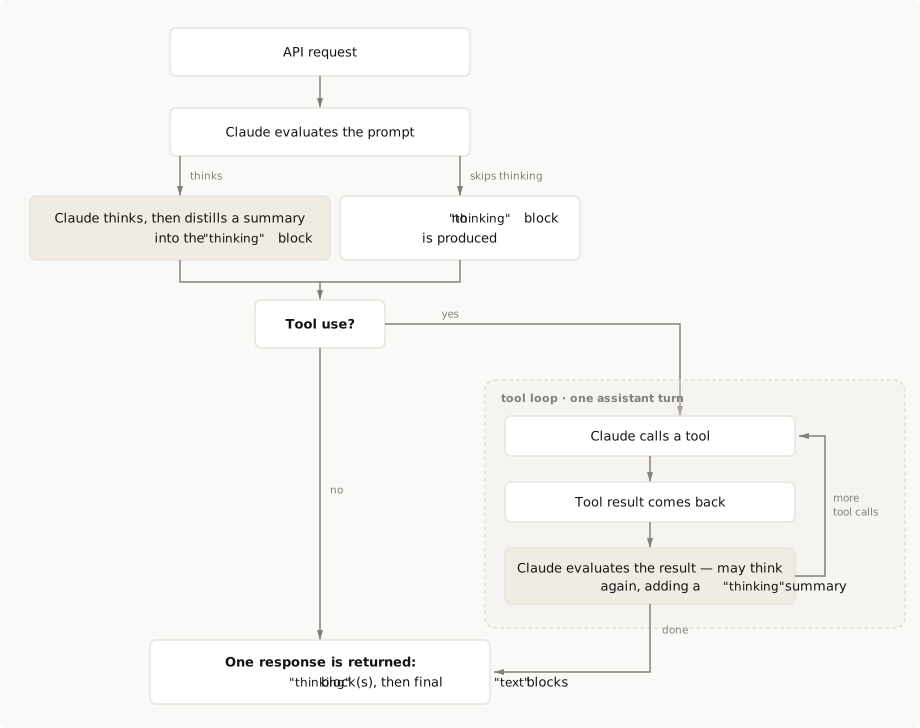
Whether Claude thinks on a given request, and how deeply, depends on your thinking configuration and the complexity of the request.
Here is what thinking looks like in a response: one or more thinking content blocks arrive before the text blocks. The thinking block is still generated content, like the text block that follows it, but it is separated from the canonical response. Each thinking block also carries a signature field, an encrypted copy of the full reasoning that you pass back unchanged in multi-turn and tool-use conversations (see Thinking encryption):
{
  "content": [
    {
      "type": "thinking",
      "thinking": "Let me break this down. The question has two parts, so I'll start with the simpler one and use its result to constrain the second...",
      "signature": "WaUjzkypQ2mUEVM36O2Txu...."
    },
    {
      "type": "text",
      "text": "Based on my analysis..."
    }
  ]
}
You don't always see this text, and what you see is never the raw chain of thought: the text in a thinking block is a summary of Claude's reasoning. The display field on the thinking configuration controls whether that summary is returned at all: "summarized" returns it, while "omitted", the default on many models, returns thinking blocks with an empty thinking field. Either way the block is billed the same and passed back the same in multi-turn conversations. See Controlling thinking display for per-model defaults and details.
If Claude uses tools, thinking can also appear between tool calls. See Thinking with tool use. For the full response format, see the Messages API reference.