1-hour cache duration
If you find that 5 minutes is too short, Anthropic also offers a 1-hour cache duration at additional cost.
The 1-hour cache duration is available on the Claude API, Amazon Bedrock, Amazon Bedrock (Opus 4.6 and earlier), Claude Platform on AWS, Google Cloud, and Microsoft Foundry.
To use the extended cache, include ttl in the cache_control definition like this:
"cache_control": {
  "type": "ephemeral",
  "ttl": "1h"
}
The response includes detailed cache information like the following:
{
  "usage": {
    "input_tokens": 2048,
    "cache_read_input_tokens": 1800,
    "cache_creation_input_tokens": 248,
    "output_tokens": 503,

    "cache_creation": {
      "ephemeral_5m_input_tokens": 148,
      "ephemeral_1h_input_tokens": 100
    }
  }
}
Note that the current cache_creation_input_tokens field equals the sum of the values in the cache_creation object.
If you see ephemeral_5m_input_tokens writes you didn't request while using server tools such as web search, see Tool use with prompt caching.
When to use the 1-hour cache
If you have prompts that are used at a regular cadence (that is, system prompts that are used more frequently than every 5 minutes), continue to use the 5-minute cache, because this will continue to be refreshed at no additional charge.
The 1-hour cache is best used in the following scenarios:
When you have prompts that are likely used less frequently than 5 minutes, but more frequently than every hour. For example, when an agentic side-agent will take longer than 5 minutes, or when storing a long chat conversation with a user and you generally expect that user may not respond in the next 5 minutes.
When latency is important and your follow up prompts may be sent beyond 5 minutes.
When you want to improve your rate limit utilization, because cache hits are not deducted against your rate limit.
The 5-minute and 1-hour cache behave the same with respect to latency. You will generally see improved time-to-first-token for long documents.
Mixing different TTLs
You can use both 1-hour and 5-minute cache controls in the same request, but with an important constraint: Cache entries with longer TTL must appear before shorter TTLs (that is, a 1-hour cache entry must appear before any 5-minute cache entries).
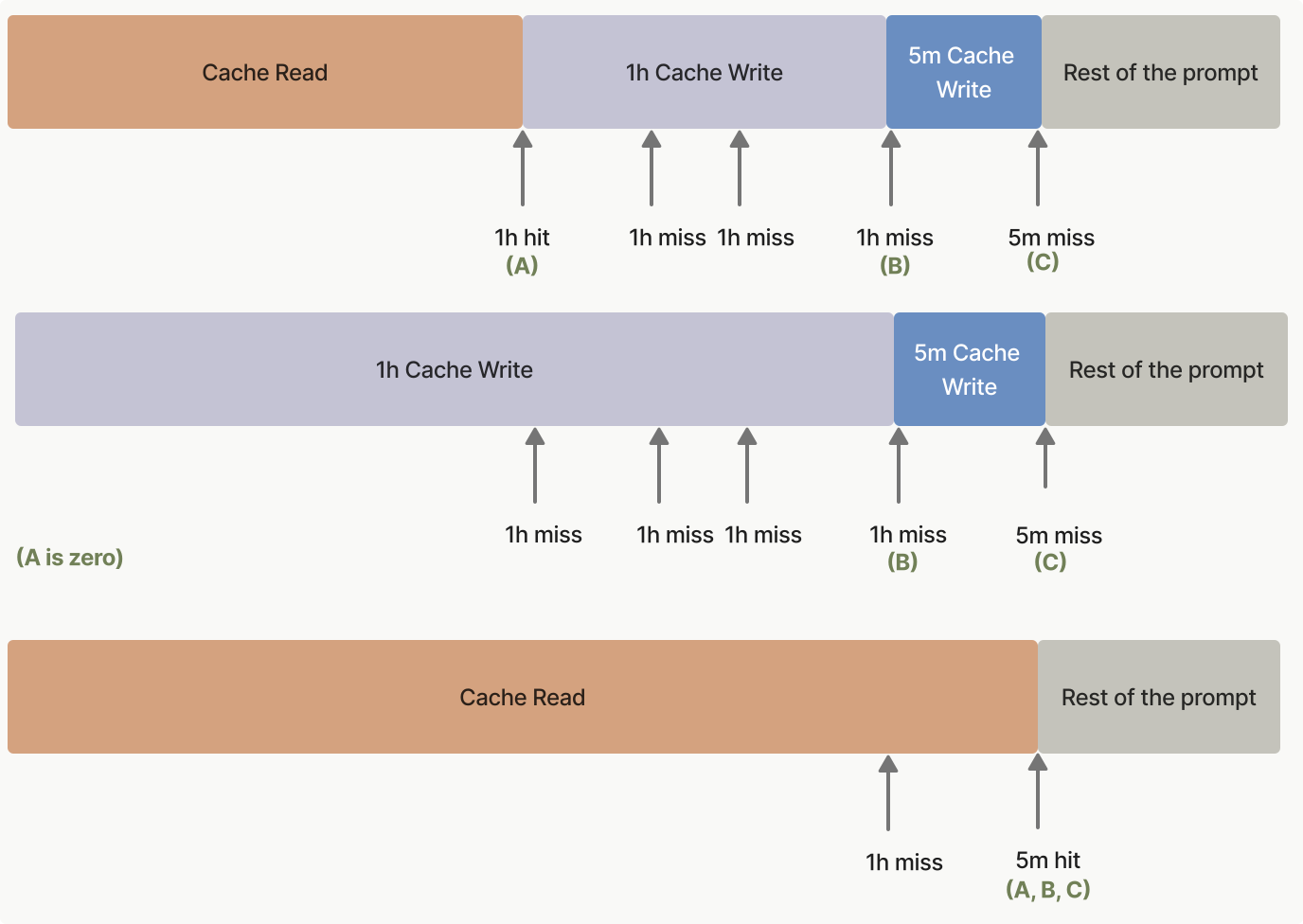
When mixing TTLs, the API determines three billing locations in your prompt:
- Position
A: The token count at the highest cache hit (or 0 if no hits). - Position
B: The token count at the highest 1-hourcache_controlblock afterA(or equalsAif none exist). - Position
C: The token count at the lastcache_controlblock.
If B or C is larger than A, it is necessarily a cache miss, because A is the highest cache hit.
You'll be charged for:
- Cache read tokens for
A. - 1-hour cache write tokens for
(B - A). - 5-minute cache write tokens for
(C - B).
Here are three examples. This depicts the input tokens of 3 requests, each of which has different cache hits and cache misses. Each has a different calculated pricing, shown in the colored boxes, as a result.