WISC Framework: Context Engineering for AI Coding
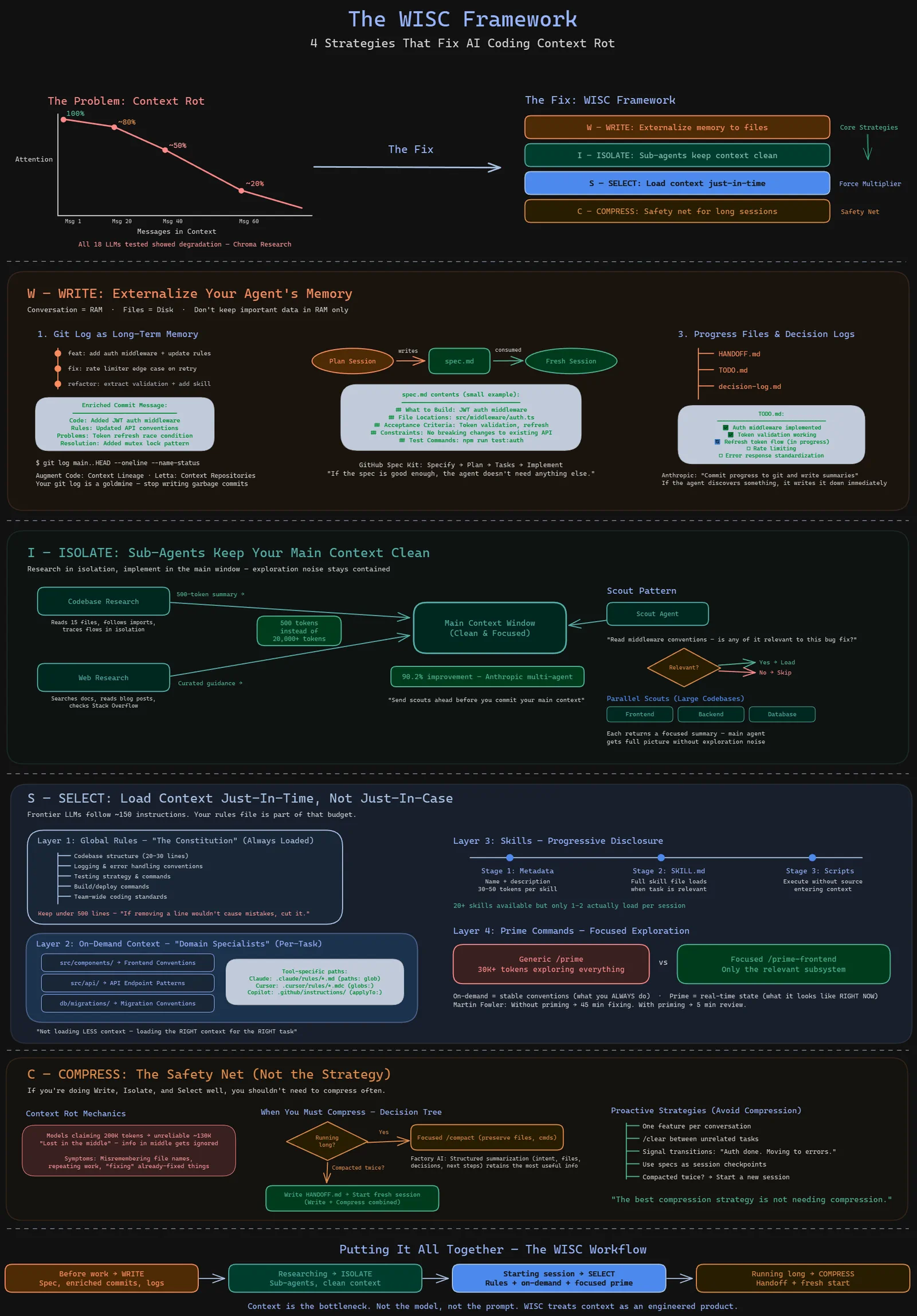
What is WISC?
WISC is a practical framework for managing AI context in coding sessions, based on Anthropic's four context engineering strategies. The acronym stands for:
WISC 是一个用于管理编码会话中 AI 上下文的实用框架,基于 Anthropic 的四种上下文工程策略。这个缩写代表:
- W - Write: Externalize your agent's memory to files so it survives context resets
- I - Isolate: Use sub-agents to keep research noise out of your main session
- S - Select: Load only the context you need for the current task, not everything
- C - Compress: When sessions run long, compress with focus or hand off to a fresh session
W — Write(写出):把 agent 的记忆外化到文件里,让它在上下文重置之后依然存活;I — Isolate(隔离):用子 agent 把调研噪音挡在主会话之外;S — Select(选择):只加载当前任务需要的上下文,而不是全部;C — Compress(压缩):当会话变得很长时,带着焦点做压缩,或者交接给一个全新的会话。
The ordering is intentional — Write and Isolate have the most impact, Select is the force multiplier, and Compress is the safety net.
这个排序是刻意安排的——Write 和 Isolate 影响最大,Select 是力量倍增器,Compress 是安全网。
The 3-Tier Context System
This use case demonstrates a progressive disclosure approach to AI context, built for Claude Code but applicable to any AI coding tool:
本用例演示了一种针对 AI 上下文的渐进式披露方法,为 Claude Code 而构建,但同样适用于任何 AI 编码工具:
Tier 1: Global Rules (CLAUDE.md)
Always loaded. Covers project structure, essential commands, architecture overview, and universal conventions. Keep this lean — under 500 lines. If removing a line wouldn't cause the AI to make mistakes, cut it.
始终加载。覆盖项目结构、必要的命令、架构概览和通用约定。保持精简——控制在 500 行以内。如果删掉某一行并不会让 AI 犯错,那就把它删掉。
Tier 2: On-Demand Rules (.claude/rules/)
Loaded automatically based on which files the agent is working with. Each rule file has a paths: frontmatter that triggers auto-loading — for example, testing.md loads when the agent touches **/*.test.ts, and web-frontend.md loads when working in packages/web/**/*.tsx.
根据 agent 正在处理哪些文件而自动加载。每个规则文件都有 paths: frontmatter 来触发自动加载——例如 testing.md 会在 agent 接触到 **/.test.ts 时加载,web-frontend.md 会在处理 packages/web/*/*.tsx 时加载。
Examples in .claude/rules-example/:
示例位于 .claude/rules-example/:
| File | Auto-loads when touching | What it covers |
|---|---|---|
testing.md | **/*.test.ts | Mock isolation rules, test batching, lazy logger patterns |
web-frontend.md | packages/web/**/*.tsx | Tailwind v4, SSE event types, React Router v7 |
database.md | **/db/** | Query patterns, migration conventions, dual DB support |
orchestrator.md | **/orchestrator/** | Session lifecycle, routing agent, streaming |
workflows.md | **/workflows/** | YAML parsing, execution modes, variable substitution |
adapters.md | **/adapters/** | Platform adapter patterns, auth, message formatting |
isolation.md | **/isolation/** | Worktree provider, error classification, environment lifecycle |
server-api.md | **/server/**, **/routes/** | API routes, SSE streaming, webhook verification |
cli.md | **/cli/** | CLI adapter, command registration, output formatting |
Tier 3: Reference Docs (.claude/docs/)
Heavy reference guides designed for sub-agent scouting. These are NOT auto-loaded. Instead, a sub-agent reads the header to determine relevance, then loads the full doc only if needed. This keeps 1,000+ lines of deep reference out of your main context.
为重型的参考指南,专为子 agent 侦察而设计。它们不会被自动加载。取而代之的是,子 agent 先读文件头部判断相关性,只在需要时才加载完整文档。这样就能把 1000 行以上的深度参考资料挡在你的主上下文之外。
Examples in .claude/docs-example/:
示例位于 .claude/docs-example/:
| File | Lines | What it covers |
|---|---|---|
architecture-deep-dive.md | 324 | Full system architecture, data flow, package dependencies |
workflow-yaml-reference.md | 309 | Complete YAML syntax for steps, loops, DAGs, variables |
adapter-implementation-guide.md | 248 | How to build a new platform adapter end-to-end |
isolation-and-worktree-guide.md | 231 | Git worktree mechanics, environment lifecycle, error handling |
Slash Commands
These implement WISC strategies as reusable slash commands in Claude Code (.claude/commands/):
这些把 WISC 策略实现为 Claude Code 中可复用的斜杠命令(.claude/commands/):
Prime Commands (Select)
Load focused codebase context at the start of a session. Instead of exploring the entire codebase (~30K+ tokens), each prime variant explores only the relevant subsystem.
在会话开始时加载聚焦的代码库上下文。每个 prime 变体不再探索整个代码库(约 3 万 token 以上),而是只探索相关的子系统。
| Command | What it primes |
|---|---|
/prime | Full codebase overview (all packages) |
/prime-backend | Core business logic + HTTP server |
/prime-frontend | React UI, SSE hooks, components |
/prime-workflows | Workflow engine (loader, router, executor, DAG) |
/prime-isolation | Git worktree isolation system |
Planning & Execution (Write)
| Command | What it does |
|---|---|
/plan-feature | Spawns sub-agents to research the codebase, then writes a detailed implementation plan to a file. The plan becomes the spec for a fresh implementation session. |
/execute | Reads a plan file and implements it step-by-step. Runs in a fresh session with only the plan as context — no planning conversation baggage. |
Session Management (Write + Compress)
| Command | What it does |
|---|---|
/handoff | Gathers git state, writes a HANDOFF.md with completed work, key decisions, dead ends, and recommended next action. The next session reads this file and picks up immediately. |
/commit | Creates an enriched commit with conventional tags, a WHY-focused body, and a Context: section that logs changes to rules, commands, or docs alongside code changes. |
How the Strategies Map to Commands
WRITE       /plan-feature  /execute  /handoff  /commit
             (specs)        (specs)   (progress) (git memory)

ISOLATE     /plan-feature spawns research sub-agents
            /prime-* commands use focused exploration
            Scout pattern: sub-agents read docs headers first

SELECT      /prime-*       .claude/rules/*.md    .claude/docs/*.md
            (focused)      (auto-loaded)          (on-demand via scouts)

COMPRESS    /handoff       /compact (built-in)
            (write+compress) (focused compaction)
Applying This to Your Project
- Start with Write — Set up enriched commits and spec-driven planning. This alone transforms your AI coding workflow.
- Add Select — Move domain-specific conventions out of your global rules into path-scoped rule files. Keep your
CLAUDE.mdlean. - Use Isolate — When researching, spawn sub-agents instead of reading files in your main session. The exploration noise stays contained.
- Compress as needed — Use focused
/compactwith explicit preservation targets, or write a/handoffand start fresh.
1)从 Write 开始——搭建富化提交与 spec 驱动的规划,仅这一步就能改变你的 AI 编码工作流;2)加入 Select——把领域专属约定从全局规则移到按路径限定的规则文件中,让 CLAUDE.md 保持精简;3)使用 Isolate——做调研时派出子 agent,而不是在主会话里读文件,让探索产生的噪音被关住;4)按需 Compress——使用带明确保留目标的聚焦式 /compact,或者写一份 /handoff 然后重新开始。
Resources
- Anthropic: Context Engineering for AI Agents
- Anthropic: Effective Harnesses for Long-Running Agents
- Martin Fowler: Knowledge Priming for AI Agents
- Progressive Disclosure for AI Coding Tools
- Context Rot Research (Chroma)
- GitHub Spec Kit
参考资料:Anthropic:面向 AI Agent 的上下文工程;Anthropic:长时运行 Agent 的有效 harness;Martin Fowler:为 AI Agent 做知识预热;面向 AI 编码工具的渐进式披露;上下文腐化研究(Chroma);GitHub Spec Kit。