Summary
Back to the initial question: if I want to build an application, where is a reliable starting point?
Everything in this article follows one main line: first clarify what an idea is, then understand its relationship with user needs, and then step by step break it into a full path that can be built, used, polished, amplified by AI, and connected to users.
In Chapter 1, we started from ideas themselves. An idea is no longer just “this feels cool,” but must target a clear user group, sit in a specific scenario, help complete a specific task, and offer a better method than the status quo. You learned to examine ideas from four dimensions: gameplay, user journey, what is being done, and what problem is being solved. You also saw the often-overlooked gap between ideas and user needs. You restrained self-indulgence, learned to distinguish real from fake needs, and recognized that good and bad ideas diverge in fate early. Then instead of waiting passively for inspiration, you learned to proactively mine clues from your own life, your reachable groups, public spaces, and existing products; then to summarize an idea in one sentence, use AI for brainstorming, and find your own user/scenario differentiation in common directions.
In Chapter 2, you moved from thinking to doing. You learned to switch between divergence and convergence: spread ideas with the double-diamond approach, then tighten to one feasible route based on user value, feasibility, and time cost. You practiced going from abstract to concrete, breaking vague wishes (like “I want an efficiency app”) into minimal executable actions until each step became today’s doable task. You used whiteboards/paper to sketch before building, split an app into entry page, operation page, and result page, and map full user flow from entry to outcome. You also stopped treating references as copying homework and instead analyzed others’ navigation, forms, result display, and guidance flows to borrow mature experience. At the same time, you stopped waiting until “fully finished” to ask users. Even at prototype and half-finished stages, you asked while drawing and asked while building, bringing real users into design early.
In Chapter 3, you gradually built your own judgment criteria to distinguish merely usable from truly good. You stopped saying vaguely “this app is okay” and started evaluating concretely whether it saves time, reduces errors, lowers communication cost, and reduces cognitive load. You understood a good app should be almost self-onboarding, naturally recalled in key scenarios, and grounded in real altruism. You also learned to map pain points to marginal costs (time, money, effort, risk). Meanwhile, you formed an initial understanding of C-end vs B-end differences: the former cares more about emotional value and spread, while the latter cares more about efficiency, cost, risk, and compliance. You stopped only trusting your own preference and built simple feedback mechanisms, using retention, revisit, and recommendation to decide whether continued investment is justified, polishing from “I think it’s good” to “users think it’s good.”
In Chapter 4, you expanded perspective from pure product to AI capability. You first restrained the impulse of “AI for AI,” and asked two serious questions: does this app stand without AI, and what exactly improves with AI. You became familiar with AI’s basic capabilities and boundaries across text, image, video, and automation; knew where to delegate to models and where human review is mandatory. You also looked beyond feature implementation and watched deeper indicators: is task time reduced, is output quality improved, is usage frequency higher, and are users willing to pay specifically for AI features.
In Chapter 5, everything returned to one practical reality: even if your app is decent, even with AI, without users its value is still zero. You learned to separate 0–1 and 1–N, temporarily put aside large topics like scale, brand, and organization, and focus on one thing first: get 20 real users to start using and come back. Instead of blind casting wide nets, you cold-started along three main lines: accumulate seed users from your nearby communities and peers; attract early tryers through content and limited benefits; and leverage existing platforms/channels where traffic already exists. You also learned to split strategy by object: seed users, supply side, traffic side, and channel side each need different approaches. With limited resources, you stopped trying everything once and instead picked the path best aligned with your strengths and easiest to start, then went deep on that one path rather than laying out ten half-finished channels at once.
Putting all this together, the method is not mysterious: start from a reliable idea rooted in real need; use drawing, writing, and decomposition to converge it into a minimum viable application; use real users and explicit metrics to polish it into a good application; introduce AI at key points to amplify value; and finally, under limited resources, use appropriate cold-start methods to find the first users willing to pay.
Next, what you need is to drop excessive fantasies, choose one direction, build it, and launch it so it enters the real world for validation. All discussions about ideas, methodology, AI, and growth must eventually land on one concrete person, one concrete scenario, and one concrete task.
For this reason, rough beginnings are fine: incomplete features, rigid flows, and simple interfaces are all fine. Even if you launch and nobody responds, and no one wants to register or pay, that is still fine. These are process states, not final conclusions. They simply tell you what to modify next. What matters is real progress: continuously review, summarize, raise your limits, and meet more people willing to give practical feedback.
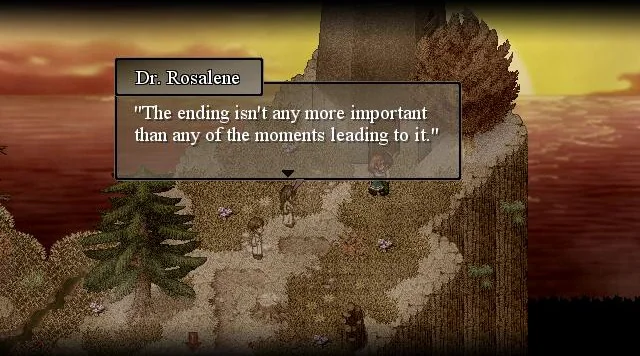
At this stage, the author believes one thing is enough: enjoy the process. As the well-known narrative game To the Moon says:
"The ending isn't any more important than any of the moments leading to it."
The ending is never more important than the process.