s12: Remote Memory — Stored Record 与 Recalled Context
Memory 是带 owner 和 source 的持久记录;Recall 是针对当前 query 生成的候选视图。两者生命周期、可信度和使用方式不同。
Harness 层:Remote memory boundary、retrieval contract 与 context provenance。
本章解决什么问题
s10 和 s11 已经分别定义了 Workspace Memory 与 User Memory。它们解决“把什么状态持久化到哪里”,但还没有回答长时间跨度下的另一个问题:
当前任务需要过去哪一段信息?
一个常见错误是把“数据库里存过的所有记忆”和“本轮应该进入 Prompt 的上下文”都叫 memory。这样会掩盖关键边界:
- 存储记录必须长期存在,并能说明属于谁、来自哪里;
- 召回结果只对某个 query 有意义,换一个 query,排名和结果都可能变化;
- 检索命中不等于事实正确,也不等于必须进入 Prompt;
- 召回不应因为读到了某条记录,就把它重新写成一条新记忆。
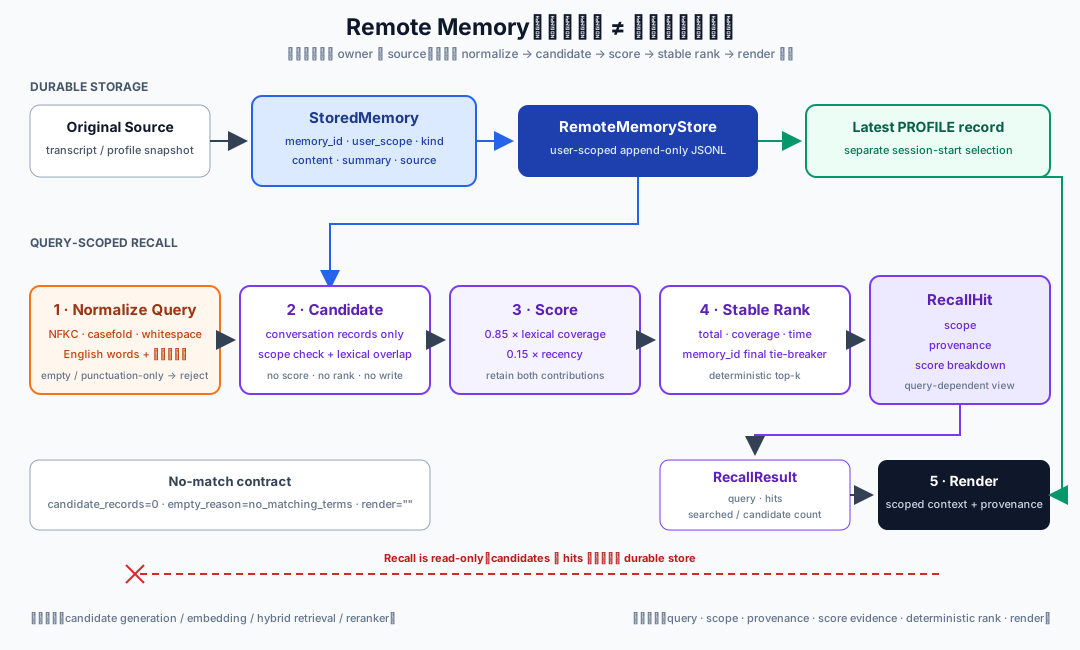
本章把召回主路径拆成五个可独立验证的阶段:
normalize -> candidate -> score -> stable rank -> render这些阶段围绕 RecallQuery、RecallCandidate、RecallScoreBreakdown、 RecallHit 和 RecallResult 传递结构化数据。任何阶段失败都能定位到 输入、候选、评分、排序或上下文渲染,而不是只看到一个无法解释的最终分数。
代码架构图
flowchart LR
    S["Source transcript / profile snapshot"] --> DB["StoredMemory JSONL"]
    Q["Raw recall text"] --> N["Normalize: NFKC + case + whitespace"]
    N --> C["Candidate: lexical overlap"]
    DB --> C
    C --> E["Score: coverage + recency breakdown"]
    E --> R["Stable rank: score + coverage + time + ID"]
    R --> H["RecallHit: scope + provenance + breakdown"]
    H --> V["Render selected context"]
    P["Latest PROFILE record"] --> I["Session-start profile injection"]
    DB --> P
图中有两条不同路径:
- 最新 Profile snapshot 在会话启动时加载,并保留
memory_id、source_id、captured_at; - Conversation records 只在模型明确调用
recall_history时参与召回,形成当前 query 的 hits。
Profile 不是 history hit,history hit 也不会被自动保存成 Profile。
核心数据契约
StoredMemory:持久记录
@dataclass(frozen=True)
class StoredMemory:
    memory_id: str
    user_scope: str
    kind: MemoryKind
    content: str
    summary: str
    source: MemorySource
    stored_at: str
StoredMemory 是远端服务中的 durable evidence。它必须有稳定 ID、用户作用域和来源。教学实现使用追加式 JSONL 模拟远端服务,进程重启后可重新读取。
MemorySource:来源
@dataclass(frozen=True)
class MemorySource:
    source_id: str
    source_type: str
    title: str
    captured_at: str
source_id 指向产生记录的原始对象,例如 transcript 或 profile snapshot。stored_at 表示记录何时进入存储,captured_at 表示来源事件发生的时间,两者不能混为一个字段。
RecallQuery:本轮检索请求
@dataclass(frozen=True)
class RecallQuery:
    query_id: str
    text: str
    normalized_text: str
    terms: tuple[str, ...]
    user_scope: str
    limit: int
    issued_at: str
召回服务看不到当前聊天,因此 text 必须自包含:说明要找什么历史信息, 而不是只写“继续上次”。原始输入先折叠空白,normalized_text 再执行 NFKC、casefold 和空白归一化;后续所有阶段只使用稳定排序的 terms。 query_id 把 candidates、scores 和 hits 绑定到同一次检索,便于工具结果、 审计和 Prompt context 对齐。
RecallCandidate:未评分候选
@dataclass(frozen=True)
class RecallCandidate:
    query_id: str
    record: StoredMemory
    searchable_terms: tuple[str, ...]
    matched_terms: tuple[str, ...]
    captured_at: datetime
Candidate 只表示某条 conversation record 与 query 存在 lexical overlap。 它还没有 score 和 rank,也不会复制或改写 StoredMemory。把候选构造单独 建模后,可以替换成倒排索引、向量召回或 hybrid retrieval,而不用改排序契约。
RecallScoreBreakdown:可解释评分
@dataclass(frozen=True)
class RecallScoreBreakdown:
    matched_terms: tuple[str, ...]
    query_term_count: int
    lexical_coverage: float
    recency: float
    lexical_contribution: float
    recency_contribution: float
    total: float
total 不是孤立数字。每条候选都携带 matched terms、query term 数量、 coverage、recency、权重和两项 contribution,因此调用方能解释“为什么命中” 以及“每部分为最终分数贡献了多少”。
RecallHit:候选视图
@dataclass(frozen=True)
class RecallHit:
    query_id: str
    memory_id: str
    rank: int
    snippet: str
    scope: RecallScope
    provenance: MemorySource
    score_breakdown: RecallScoreBreakdown
RecallHit 不是复制出来的新记忆。它只是某条 StoredMemory 针对当前 query 的检索投影。scope 明确用户边界与 memory kind,provenance 指回原始来源, score_breakdown 解释本次排序。再次查询时,这些字段可以完全不同。
为避免破坏已有 Layered Memory walkthrough,Python 对象仍提供 hit.source 和标量 hit.score 兼容视图;新代码应读取 provenance 与 score_breakdown。JSON 工具结果也暂时保留 source 兼容别名。
主要代码流程
1. Store:写入带来源的远端记录
store.append(
    kind=MemoryKind.CONVERSATION,
    memory_id="memory-42",
    content="Selected SQLite WAL for local persistence.",
    summary="Selected SQLite WAL.",
    source=MemorySource(
        source_id="transcript-42",
        source_type="conversation_transcript",
        title="Persistence decision",
        captured_at="2026-08-01T12:00:00Z",
    ),
)
写入前会验证内容,并把 user_scope 写进每条 JSONL 记录。RemoteMemoryStore.append() 使用与 JSONL 同目录的 advisory lock,把“读取现有 ID、拒绝重复 ID、一次 O_APPEND 写入、fsync”放进同一个独占临界区。两个协作进程即使同时提交相同 memory_id,也只能有一个成功,另一个得到明确的 RemoteMemoryDuplicateError;读取时 scope 不一致仍会失败,避免远端历史跨用户泄漏。
这里的文件锁是本地教学实现对服务端原子 compare-and-insert 的模拟。它解决同一存储路径上协作 writer 的 check-then-act 竞态;真实远端 Memory 服务应使用数据库唯一索引、条件写或事务,而不是依赖客户端文件锁。
2. Normalize:构造唯一的规范化 Query
result = RecallEngine(store).recall(
    "  LAYERED   Memory  ",
    limit=5,
)
RecallEngine 不会访问 Agent 当前 messages,因此工具描述明确要求模型重述历史 主题。normalize_recall_query() 保留可读文本 "LAYERED Memory",同时生成 normalized_text="layered memory" 和稳定 terms。英文按单词切分;连续中文 补充二元字符特征,例如“分层记忆”得到“分层 / 层记 / 记忆”。空白 query 直接拒绝,只有标点且没有 searchable term 的 query 也明确失败。
3. Candidate:只构造存在 lexical overlap 的候选
build_recall_candidates() 只读取 CONVERSATION records,并再次校验每条 record 的 user_scope 与 query 一致。候选保存 searchable terms、matched terms 和来源时间,但此时没有 score、rank,也没有写回 durable store。
searched_records 表示检查了多少条 conversation records; candidate_records 表示其中多少条进入评分。两者分开后,无结果时可以判断 问题发生在语料为空、没有词项重合,还是后续 top-k 选择。
4. Score 与 Stable Rank:解释分数,固定并列顺序
教学 ranker 使用一个透明的离线基线:
lexical_contribution = 0.85 * query-term coverage
recency_contribution = 0.15 * recency
total = lexical_contribution + recency_contribution
score_recall_candidate() 返回完整 breakdown,而不是只返回 total。 stable_rank_recall_candidates() 使用以下显式排序键:
total DESC
-> lexical_coverage DESC
-> source.captured_at DESC
-> memory_id ASC
最后一个稳定 ID 消除了 JSONL 插入顺序对并列结果的影响。相同输入、相同 as_of 和相同 records 会得到相同排名。
这个公式不是对生产检索实现的描述,而是为了让课程可以离线测试:读者能直接解释一条记录为什么命中、为什么排在另一条之前。
5. Result:返回结构化工具结果
recall_history 返回 JSON,而不是预先排版的 Markdown:
{
  "query": {
    "query_id": "...",
    "text": "LAYERED Memory",
    "normalized_text": "layered memory",
    "terms": ["layered", "memory"],
    "user_scope": "...",
    "limit": 5
  },
  "hits": [
    {
      "memory_id": "conversation-003",
      "rank": 1,
      "scope": {
        "user_scope": "...",
        "memory_kind": "conversation"
      },
      "provenance": {
        "source_id": "transcript-conversation-003",
        "source_type": "conversation_transcript",
        "title": "layered memory design",
        "captured_at": "..."
      },
      "source": {
        "source_id": "transcript-conversation-003",
        "source_type": "conversation_transcript",
        "title": "layered memory design",
        "captured_at": "..."
      },
      "score": 0.995161,
      "score_breakdown": {
        "matched_terms": ["layered", "memory"],
        "query_term_count": 2,
        "lexical_coverage": 1.0,
        "recency": 0.967742,
        "weights": {
          "lexical": 0.85,
          "recency": 0.15
        },
        "contributions": {
          "lexical": 0.85,
          "recency": 0.145161
        },
        "total": 0.995161
      }
    }
  ],
  "searched_records": 6,
  "candidate_records": 1,
  "empty_reason": null
}
结构化结果让 Harness 可以记录审计、显示来源、根据 Context budget 截断,或在后续版本中插入 reranker,而不必再解析人类文本。
6. Render:只渲染选中的候选
<recalled_context query_id="query-1"
                   normalized_query="layered memory"
                   user_scope="...">
  <hit rank="1" memory_id="conversation-003"
       user_scope="..." memory_kind="conversation">
    <score total="0.995161"
           lexical_coverage="1.000000"
           recency="0.967742"
           lexical_contribution="0.850000"
           recency_contribution="0.145161"/>
    <provenance source_id="transcript-conversation-003"
                source_type="conversation_transcript"
                captured_at="..."/>
    <snippet>Separated workspace, user and remote memory boundaries.</snippet>
  </hit>
</recalled_context>
即使进入 Prompt,hit 仍保留 query、scope、provenance 和 score breakdown。 模型看到的是“本轮召回候选”,而不是没有来源的事实段落。无匹配时 RecallResult 返回 empty_reason="no_matching_terms",renderer 返回空字符串, 避免为一个空 wrapper 消耗 Prompt budget。
Profile 为什么单独加载
Remote Profile 也是一种 stored record,但选择策略不同:
- Profile 是某个时间点的服务端快照;
- 会话启动时只选最新 snapshot;
- Profile 保留来源元数据,不伪装成 s11 用户显式偏好;
- Profile records 不参加 conversation recall;
- 历史 conversation hits 也不会自动覆盖 Profile。
系统提示中的 Profile block 因此包含 provenance:
<remote_profile memory_id="profile-001"
                source_id="profile-snapshot-001"
                captured_at="...">
  ...profile content...
</remote_profile>
这比匿名 <memory> 文本更容易解释:调用方能知道注入了哪一个 snapshot,以及它何时产生。
为什么今天不加复杂 reranker
当前章节要先稳定的是接口,而不是追求更花哨的召回分数:
normalized query
-> source-bearing candidates
-> score breakdown
-> stable rank
-> scoped/provenanced hits
-> rendered context
如果现在同时加入 embedding、hybrid search、LLM reranker、时间过滤和反馈学习,读者很难判断问题发生在召回、排序还是 Prompt 注入。保持 ranker 简单,可以先验证:
- query 是否自包含;
- normalize 是否让中英文输入稳定;
- candidate 数量是否能和 searched records 区分;
- hit 是否绑定正确 query;
- scope 与 provenance 是否完整;
- score 的每项 contribution 是否可解释;
- 并列分数是否不依赖存储迭代顺序;
- limit 和 scope 是否生效;
- recall 是否保持只读。
以后替换 ranker 时,只要仍返回同一个 RecallResult 契约,上层 Agent tool 和 Prompt assembly 不需要重写。
与 s09、s10、s11 的边界
| 模块 | Owner | 核心对象 | 回答的问题 |
|---|---|---|---|
| s09 Transcript | session | event evidence | 这一轮真实发生了什么? |
| s10 Workspace Memory | workspace | durable project facts | 这个项目长期有效什么? |
| s11 User Memory | user | profile + explicit preferences | 这个用户跨项目默认怎样? |
| s12 Remote Memory | remote user/service | stored records + recall hits | 当前问题需要哪段长期历史? |
s09 transcript 可以成为 s12 StoredMemory 的 source,但“有 transcript”不等于“必须召回”。s12 负责把大量长期记录变成本轮少量候选。
失败与边界行为
- 空 query:在 normalize 阶段拒绝调用;
- 只有标点、没有 searchable term:明确拒绝,而不是退化成全量召回;
limit不在 1 到 10:拒绝调用;- 重复
memory_id:拒绝写入; - 并发提交相同
memory_id:查重与追加在同一临界区内完成,只保留一条可重启读取的记录; - JSONL 中的
user_scope不匹配:拒绝读取; - 没有匹配:返回带 query、searched/candidate count 和
empty_reason="no_matching_terms"的空hits,renderer 不注入空上下文; - Recall 多次执行:不会改变 durable store;
- Profile snapshot:只用于 profile selection,不混入 conversation hits。
无 key 组合边界
RemoteMemoryStore、RecallEngine 和 context renderer 都是纯本地机制。导入这些类型时不应要求模型配置,也不应因为 import 就向默认目录写 seed records。因此在线副作用分成两个延迟入口:
default_runtime()  -> 首次运行交互 CLI 或 recall_history 时创建教学 store
runtime_client()   -> online agent_loop 真正请求模型时才校验 MODEL_ID
这让其他章节和 Layered Memory Walkthrough 可以直接复用 S12 的存储与召回契约,而不需要伪造 API key。章节 CLI 的行为不变:真正进入 online loop 时,缺少模型配置仍会明确失败。
离线验证
新增测试覆盖:
- StoredMemory 的 source provenance 和跨重启读取;
- Query normalization、Candidate、Score breakdown、Scope、Provenance 与 Rank 契约;
- 英文大小写/空白归一化与中文二元字符召回;
- 空白、纯标点 query 的失败边界;
- 分数并列时按显式 tie-breakers 稳定排序;
- 无结果时的 candidate count、empty reason 和空 renderer;
- Recall 是只读派生视图,不会追加存储;
- 最新 Profile 注入与 conversation recall 隔离;
- 跨用户 scope 文件拒绝;
- Prompt context 保留 query/source/score;
- 工具输出是结构化 JSON,而非预格式化历史文本。
- 导入 S12 时不构造 provider client,也不创建默认 store。
运行:
python3 -m pytest -q tests/test_remote_memory.py
python3 scripts/verify.py
离线查看章节能力增量:
python s12_cloud_memory/code.py --demo模型交互示例:
MODEL_ID=<model> ANTHROPIC_API_KEY=<key> python s12_cloud_memory/code.py教学状态默认写入 ~/.learn_workbuddy/remote-memory/。可以设置 WORKBUDDY_HOME 和 WORKBUDDY_USER_ID 隔离运行目录与用户作用域。
面试表达
我把远端记忆的召回主路径设计成 normalize -> candidate -> score -> stable rank -> render:Query 同时保留可读文本 与稳定 terms;Candidate 和 Scoring 分离;每个 hit 都携带 scope、provenance 与 score breakdown;并列分数使用确定性的时间和 ID 键排序。召回是只读派生视图, 无匹配也以显式数据返回。这样后续替换成 embedding、hybrid retrieval 或 reranker 时,所有权、来源、排序证据和 Prompt renderer 的 Harness 契约仍稳定。
下一课
s12 已经把大量远端记录压缩成少量、带来源的 recall hits。工具本身仍可能返回很大的内容;s13 将处理大输出外部化,让 Prompt 中保留指针而不是完整结果。