Harness Engineering Study Guide
A deep-dive learning archive on Harness Engineering — from concept to practice
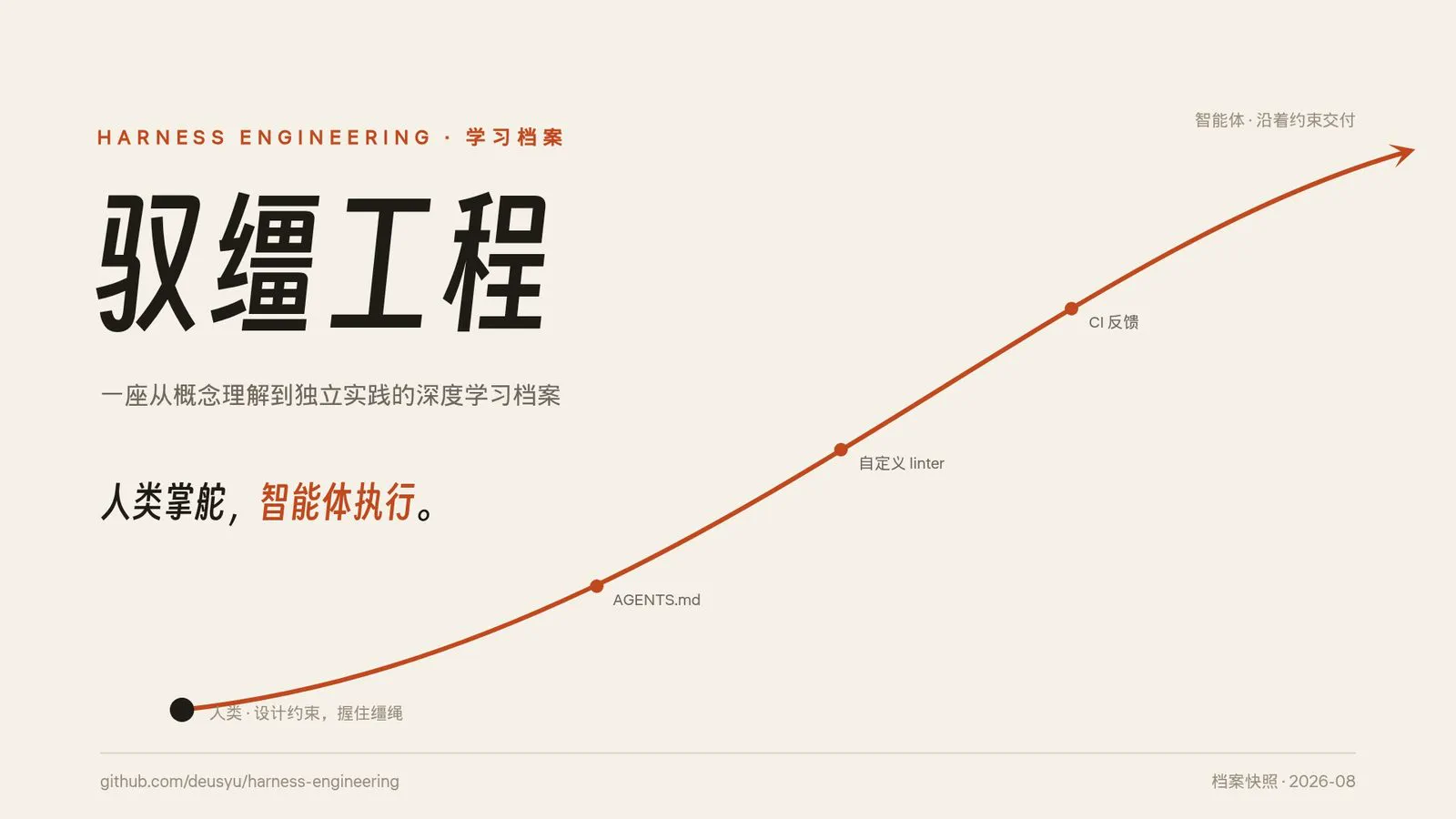
Cover from the repo's own intro deck + poster — generated with the open-kimi-ppt skill; editable PPTD sources live in this repo
Introduction
This is an evolving learning project. Harness Engineering is an engineering paradigm proposed by OpenAI in February 2026: engineers stop writing code and instead design environments, clarify intent, and build feedback loops so AI agents can work reliably.
Humans steer. Agents execute.
This repository documents the full learning journey — from reading the original article, breaking down concepts, forming independent thoughts, hands-on experiments, to producing shareable work. We hope it helps others exploring AI-native engineering.
Source: OpenAI — Harness Engineering: Harnessing Codex in an Agent-First World
Note: The insights shared here are not universally applicable. Please adapt them to your own context.
⚡ In One Sentence
Traditional:          Humans write code → Machines run code
Harness Engineering:  Humans design constraints → Agents write code → Machines run code
The core shift: an engineer's output moves from code to constraint systems — AGENTS.md, architecture rules, custom linters, and feedback loops.
🧭 Six Core Concepts
1. Repo as System of Record — If it's not in the repo, it doesn't exist for the agent
Slack threads, Google Docs, knowledge in people's heads = invisible to the agent. All decisions, specs, and plans must be committed as versioned artifacts.
2. Map, Not Manual — AGENTS.md is a table of contents, not an encyclopedia
A ~100-line entry file pointing to deeper docs. Progressive disclosure: the agent starts from a small, stable entry point and is guided where to look next. Three ways a giant instruction file fails: crowds out context, impossible to maintain, can't be mechanically verified.
→ See concepts/00-overview.md
3. Mechanical Enforcement — Docs rot; lint rules don't
Custom linters + structural tests = invariant guardians. Lint error messages embed fix instructions so agents can self-correct. Enforce boundaries centrally, allow autonomy locally.
4. Agent Readability — Optimize for the agent's ability to reason
Prefer "boring" technologies (stable APIs, well-represented in training data). Sometimes re-implementing a focused subset is cheaper than wrapping opaque upstream behavior. Make the app launchable per git worktree.
5. Throughput Changes Merge Philosophy — Correction is cheap; waiting is expensive
Short PR lifecycles. Flaky tests resolved by re-runs rather than blocking indefinitely. In a system where agent throughput far exceeds human attention, this is usually the right call.
6. Entropy Management = Garbage Collection — Tech debt is a high-interest loan
Agents reproduce existing patterns in the repo — including bad ones. Codify "golden rules" into the repo. Run periodic background tasks to scan for drift, update quality scores, and open targeted refactoring PRs.
🔑 Key Data Points
| Metric | Data |
|---|---|
| Team size | 3 → 7 engineers |
| Time span | 5 months |
| Codebase | ~1 million lines |
| PRs merged | ~1,500 |
| PRs per engineer per day | 3.5 (still growing after scaling) |
| Single run duration | 6+ hours (often during human sleep) |
| Efficiency estimate | ~1/10 of manual coding time |
📂 Repository Structure
harness-engineering/
├── README.md              ← Chinese (primary)
├── README.en.md           ← You are here
├── AGENTS.md              ← Repo navigation entry (for agents)
│
├── concepts/              # Phase 1: Concept notes (8 articles)
│   ├── 00-overview.md     #   Overview of all six concepts
│   ├── 01-repo-as-...     #   Repo as source of truth
│   ├── 02-mechanical-...  #   Mechanical enforcement
│   ├── 03-entropy-...     #   Entropy & garbage collection
│   ├── 04-agent-...       #   Agent readability
│   ├── 05-throughput-...  #   Throughput changes merge philosophy
│   ├── 06-harness-...     #   Harness definition (Fowler control-theory extension)
│   └── 07-spec-as-product.md #   Spec as product (Symphony extension)
│
├── thinking/              # Phase 2: Independent analysis (11 articles)
├── practice/              # Phase 3: Hands-on experiments (1 Ralph Demo)
├── feedback/              # Phase 4: Lessons learned (1 article)
├── works/                 # Phase 5: Shareable outputs (40 translations + 1 original + 2 external Chinese captures)
├── tools/                 # Tools that reduce the 6 complexity dimensions
├── prompts/               # Validated prompts collection
└── references/            # External resource index (79 articles with deep summaries)
Each subdirectory has its own AGENTS.md explaining its purpose and conventions — a direct practice of the "progressive disclosure" principle from the original article.
🚀 Learning Path
- [x] Phase 1: Understand core concepts — 8 concept notes covering OpenAI's six concepts + Fowler's control-theory extension + Symphony's spec-as-product
- [x] Phase 2: Form your own opinions — 11 independent analyses (ongoing)
- [x] Phase 3: Pick a small project to practice — Ralph Demo completed (321s, $0.31)
- [x] Phase 4: Record feedback & iterations — 1 article (ongoing)
- [x] Phase 5: Produce shareable work — 40 professional translations + 1 original synthesis + 2 external Chinese captures
📚 Research Library
79 articles across three knowledge tracks + 2 extended readings:
| Track | Coverage | Perspectives |
|---|---|---|
| AI-Era Harness Engineering | 75 articles | OpenAI → Fowler → Anthropic → LangChain → Stanford → Claude Code reverse engineering & source leak → Subagent runtime → Sensors/SPDD/ADLC → Out-of-scope, safety auditing & quality postmortems → Evaluation trilogy → Dynamic workflows → Origins (Ralph / Hashimoto) & discipline synthesis → Codex harness anatomy → Loop Engineering trilogy → Self-evolving harnesses & RSI → Formal verification → Multi-agent scaling (Cursor / C compiler) → Official containment & evals methodology → Behavior maps / DSLs / local models / outer-loop accountability → industrial-scale mechanical porting (Bun) & harness-model co-evolution (HarnessX) → long-running harness foundations & eval-environment confounders (Anthropic backfill) → harness operations metrics & reward hacking (Cursor backfill) → tool schemas are not neutral → the software-factory debate (Dex Horthy / Osmani) → agent-swarm cost economics → deleting 80% of the system prompt → a code-review-sensor benchmark (ReviewBench) → empirical refutation of TDD-as-process (Böckeler) → practical loop engineering (Osmani) → an org-scale adoption snapshot (Zalando) → open neutral harnesses & white-box compaction (Pi duo) → frozen-artifact cross-model transfer (StarHarness) |
| Cloud-Native Harness.io | 2 articles | CI/CD platform architecture (same name, different meaning) |
| Efficiency Paradox & Capability Evolution | 2 articles | YDD systematic teardown + METR follow-up (measurement-methodology crisis) |
| Extended Reading | 2 articles | Context Engineering, Human-Agent collaboration |
See references/articles.md — each article includes core thesis, key data, and cross-article connections.
📖 Translations
40 Chinese translations of key articles (click to expand)
🛠️ Development Notes
The repo ships with a consistency checker, scripts/check-consistency.sh, guarding against count and fidelity drift across fourteen layers of checks:
- C1-C2 —
references/articles.mdarticle count + its 4 downstream claim sites (README × 2 badges,prompts/deep-research-tracker.mdheader,references/AGENTS.mdoverview) - C3 — actual
*.mdfile counts inconcepts//thinking//feedback/match the README "X 篇" claims - C4 —
works/*-translation.mdfile count matches every translation-count claim (badges, table summaries, Phase 5 mentions, AGENTS snapshot, table row counts) - C5 — the README structure tree lists every single
concepts/*.mdfile - C6 — the "不计入 N 篇" exclusion note at the end of
references/articles.mdmatches the C1 authority count - C7 — per-track counts (Track 1/2/3) stay consistent across their 4 downstream claim sites (README research-library tables × 2,
references/AGENTS.mdtrack headings,prompts/deep-research-tracker.mdtrack lines) - C8 — local translation-pipeline guard: once
translate/<...>/sources/<slug>/source-full.mdis captured, the matching01-analysis.mdmay no longer claim "abstract-only / fetch full text later".translate/is gitignored, so this auto-SKIPs on CI and clean clones - C9 — authored prose in
concepts//thinking//feedback/must not restate library counts ("N articles / N translations") as live facts; historical mentions must carry a dated-snapshot qualifier, otherwise drop the number and linkreferences/articles.md - C10 — figure fidelity (purely local, zero network): every translation's frontmatter must declare
sourceFigureCount, the body must embed at least that many images, and every local embed path must exist on disk (null= source unavailable / unaudited → SKIP) - C11 — markdown table shape: in the checked files, every table row must carry the same cell count as its header
- C12 — every numbered entry in
references/articles.mdmust carry the 作者: and 日期: fields - C13 — zero-figure claims need an audit trail. C10 can only falsify OVER-claiming, so
sourceFigureCount: 0is unfalsifiable locally — that hole shipped a false 0 on 2026-07-27 (the source had 4 body figures). Any translation claiming 0 must therefore also carrysourceFigureAuditcontaining aYYYY-MM-DDdate, stating how the claim was verified - C14 — docs-site harness integrity: the VitePress sidebar and every displayed count must be derived from the filesystem at build time by
.vitepress/sidebar.mjs; site sources (index.md,.vitepress/**) must not hardcode counts, andnode .vitepress/sidebar.mjs --verifyasserts every first-class content file appears in the generated sidebar exactly once and rejects any symlink in the repo (symlinks can leak external files into the published artifact). On the artifact side,scripts/verify-dist.mjsasserts published pages and their.mdcopies correspond one-to-one, that relative links and images inside the copies resolve, and that dist contains no symlinks
Enable the pre-commit hook after first clone:
git config core.hooksPath .githooksOnce enabled, every commit touching the README, AGENTS.md, references/articles.md, references/AGENTS.md, index.md, .vitepress/, scripts/check-consistency.sh, or any *.md (nested included) under concepts/ / thinking/ / feedback/ / works/ / practice/ / tools/ / prompts/ runs the checks automatically; staging a symlink at any path is rejected outright (the repo-wide C14 ban, judged on the staged state). Unrelated commits are left alone.
Run manually: bash scripts/check-consistency.sh
CI backstop: even without the local hook, GitHub Actions (.github/workflows/consistency.yml) runs the same script on every push / PR (no path filters, so the branch-protection required check always gets reported). The local hook is fast feedback during development; CI is the actual merge gate.
See the "机械化检查" section of the root AGENTS.md for details.
🪞 The repo is its own harness (self-reference)
This archive now curates itself.
Bringing in outside research no longer runs on vibes — it follows a pipeline frozen into a skill,
curate-research: review is automated by parallel agents (the feedback loop),scripts/check-consistency.shkeeps counts and fidelity from drifting via C1–C14 (the mechanical rail), and whether something gets in is always a human gate (humans steer, agents execute).So the constraints themselves became the product — exactly what concepts/07-spec-as-product.md argues, except this time the subject is the repo itself.
🤝 Contributing
Contributions via Issues and PRs are welcome:
- Add concept notes (
concepts/has gaps to fill) - Share your independent thinking (
thinking/) - Contribute practice cases (
practice/) - Recommend related resources (
references/)
📞 Contact
| Channel | Link |
|---|---|
| GitHub | @deusyu |
| X (Twitter) | @0xdeusyu |
| Telegram | @DeusThink |
| Telegram Group | @talkdeusyu |
| Telegram Channel | @lovedesuyu |
| rainman.deus@gmail.com |
📄 License
MIT